Word Explanation
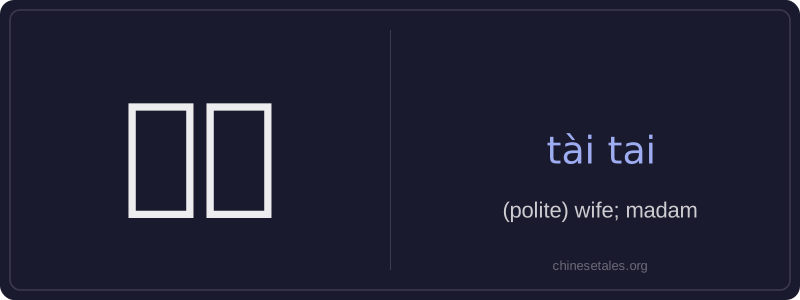
'Tàitai' is a respectful, polite term for 'wife', used especially when referring to someone else's wife or addressing a married woman formally. Though composed of two identical characters—both meaning 'extreme' or 'excessive' in classical usage—the reduplicated form evolved historically into an honorific title, similar to 'Madam' or 'Mrs.' in English. It carries connotations of maturity, respect, and social standing, and is commonly heard in formal introductions, business settings, or polite conversation.
The term is not used for one’s own wife (where you’d say 'wǒ tàitai' only in third-person narration or indirect reference), nor for unmarried women. It’s also occasionally used as a standalone title of address, like 'Zhāng tàitai' (Mrs. Zhang). While the characters literally mean 'too/very', their combined meaning here is purely conventional and honorific—not descriptive—so learners should avoid interpreting it literally.
Example Sentences
Related Words
我的
我的 (wǒ de) is a possessive pronoun meaning 'my'
这么
这么 (zhè me) is an adverb meaning 'so' or 'this
这边
这边 (zhè biān) literally combines 这 (zhè, 'th
中国
‘Zhōngguó’ literally means ‘Middle Kingdom’
中学
'Zhōngxué' literally combines 'zhōng' (middle)
见面
见面 literally means 'see face' — combining 见 (t
后来
Later (hòulái) is an adverb meaning 'afterwards'
背后
背后 literally means 'back + behind' and functions