Word Explanation
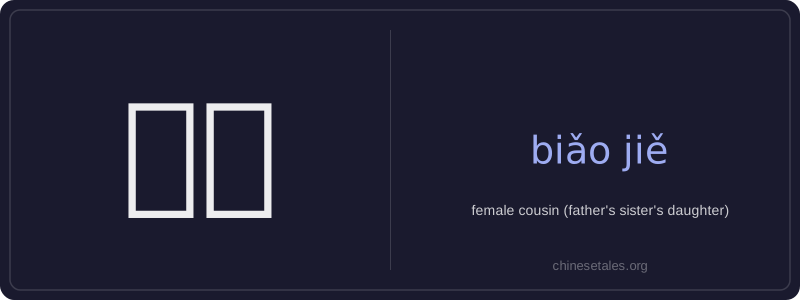
‘Biǎo jiě’ refers specifically to a female cousin on your father’s side — more precisely, the daughter of your father’s sister. The character ‘表’ (biǎo) denotes relatives connected through marriage or lateral family lines (as opposed to ‘亲’, which marks direct blood relations), while ‘姐’ (jiě) means ‘older sister’ and signals both gender and relative age — she must be older than the speaker. Unlike English ‘cousin’, which is gender- and age-neutral, Chinese kinship terms like ‘biǎo jiě’ encode precise generational, gender, and lineage information.
This term is commonly used in family conversations, introductions, and formal or semi-formal contexts when referring to extended family members. It reflects the importance of relational precision in Chinese social language. You would not use it for cousins on your mother’s side — those are ‘táng jiě’ (mother’s brother’s daughter) or ‘biǎo mèi’ (father’s sister’s younger daughter), depending on age and lineage. ‘Biǎo jiě’ is neutral in register but carries warmth and familiarity in daily use.
Example Sentences
Related Words
我的
我的 (wǒ de) is a possessive pronoun meaning 'my'
这么
这么 (zhè me) is an adverb meaning 'so' or 'this
中学
'Zhōngxué' literally combines 'zhōng' (middle)
这边
这边 (zhè biān) literally combines 这 (zhè, 'th
中国
‘Zhōngguó’ literally means ‘Middle Kingdom’
见面
见面 literally means 'see face' — combining 见 (t
后来
Later (hòulái) is an adverb meaning 'afterwards'
背后
背后 literally means 'back + behind' and functions