Word Explanation
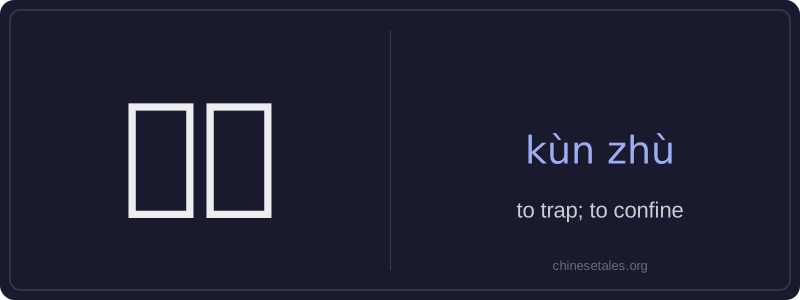
‘困住’ is a compound verb meaning 'to trap' or 'to confine' — literally, 'to make unable to move (困)' and 'to hold in place (住)'. The first character 困 carries the core sense of being stuck, restricted, or immobilized — often physically, but sometimes psychologically. The second character 住 emphasizes cessation of movement or anchoring in a fixed state. Together, they form a resultative verb phrase that describes successfully restricting someone or something so it cannot escape or proceed freely.
This word is commonly used in both literal and figurative contexts: animals caught in nets or cages, people stranded by weather or mechanical failure, or even abstract situations like being 'trapped' by debt or obligations. It implies an external force or circumstance causing the confinement, and often suggests urgency or difficulty in escaping. While it can be used transitively with a direct object (e.g., 困住小猫), it does not take aspect particles like 了 or 过 as freely as simple verbs — the completion is usually marked by context or adverbs like 已经 or 终于.
Example Sentences
Related Words
背后
背后 literally means 'back + behind' and functions
认同
‘认同’ (tóng rèn) is a verb meaning ‘to ident
面条
‘面条’ (miàn tiáo) literally means ‘flour str
认为
‘认为’ (rèn wéi) is a transitive verb meaning
无论谁
‘无论谁’ (wú lùn shéi) is a pronoun meaning
不对
不对 (bù duì) literally combines 不 (bù), meani
中学
'Zhōngxué' literally combines 'zhōng' (middle)
见面
见面 literally means 'see face' — combining 见 (t