Word Explanation
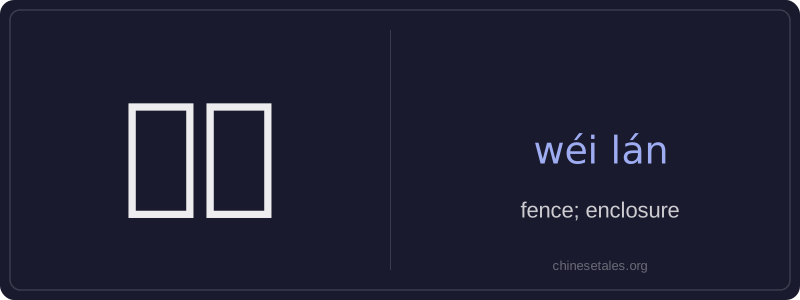
‘围栏’ literally combines ‘围’ (wéi), meaning ‘to encircle’ or ‘to surround’, and ‘栏’ (lán), meaning ‘railing’, ‘barrier’, or ‘pen’. Together, they form a compound noun meaning a physical structure—such as posts and wire, wood, or metal—that encloses an area to keep people or animals in or out. It’s commonly used for livestock enclosures on farms, playground boundaries, construction site perimeters, or garden borders.
Unlike the more general term ‘ fence’ (篱笆 líba, often made of bamboo or twigs) or ‘wall’ (墙 qiáng), ‘围栏’ emphasizes function over material: it implies intentional containment or separation, especially in practical, outdoor, or agricultural settings. It carries no strong emotional or stylistic connotation—it’s neutral, standard Mandarin, widely understood across regions and registers.
Example Sentences
Related Words
背后
背后 literally means 'back + behind' and functions
认同
‘认同’ (tóng rèn) is a verb meaning ‘to ident
面条
‘面条’ (miàn tiáo) literally means ‘flour str
认为
‘认为’ (rèn wéi) is a transitive verb meaning
无论谁
‘无论谁’ (wú lùn shéi) is a pronoun meaning
不对
不对 (bù duì) literally combines 不 (bù), meani
中学
'Zhōngxué' literally combines 'zhōng' (middle)
见面
见面 literally means 'see face' — combining 见 (t