Word Explanation
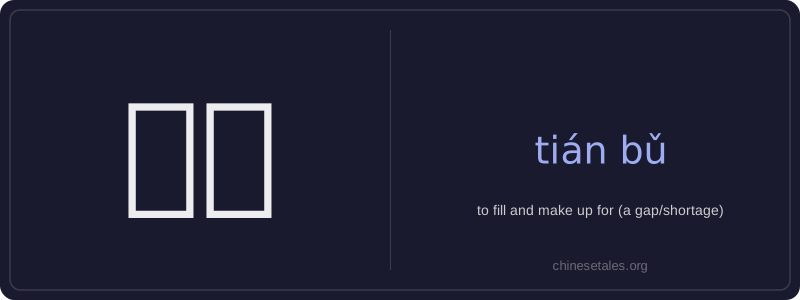
填补 (tián bǔ) is a compound verb meaning 'to fill and make up for'—typically a gap, shortage, vacancy, or deficiency. The first character 填 (tián) means 'to fill (in)', as in filling a form or space; the second, 补 (bǔ), means 'to supplement', 'to repair', or 'to compensate'. Together, they emphasize both physical or conceptual filling *and* functional restoration: it’s not just occupying empty space, but restoring completeness or adequacy. This word is commonly used in formal, written, or professional contexts—such as economics, education, staffing, or infrastructure—where deficits need active correction.
It often appears with objects like 缺口 (gap), 空缺 (vacancy), 不足 (shortage), or 损失 (loss). While it can be used transitively ('fill X'), it may also appear in passive or resultative constructions (e.g., 被填补, 填补了…). It carries a neutral-to-positive connotation, suggesting effective, purposeful action rather than mere stopgap measures.
Example Sentences
Related Words
面条
‘面条’ (miàn tiáo) literally means ‘flour str
背后
背后 literally means 'back + behind' and functions
认同
‘认同’ (tóng rèn) is a verb meaning ‘to ident
中学
'Zhōngxué' literally combines 'zhōng' (middle)
认为
‘认为’ (rèn wéi) is a transitive verb meaning
认可
认可 (rèn kě) is a formal, transitive verb meani
无论谁
‘无论谁’ (wú lùn shéi) is a pronoun meaning
不对
不对 (bù duì) literally combines 不 (bù), meani