Word Explanation
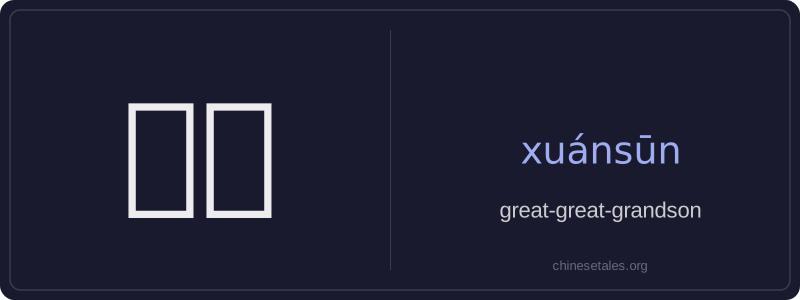
‘玄孙’ (xuánsūn) literally means ‘mysterious grandson’, but historically ‘xuán’ here functions as a classical term indicating great distance in generational descent—not mystery in the modern sense. It refers specifically to the son of one’s great-grandchild, i.e., the fourth generation below oneself: you → child → grandchild → great-grandchild → great-great-grandchild (xuánsūn). The character ‘孙’ means ‘grandson’, and ‘玄’ serves as a prefix denoting remoteness or depth in lineage, commonly used in classical Chinese kinship terminology.
This term appears most often in formal family records, genealogies, historical texts, or respectful speech about elderly relatives’ descendants. It is rarely used in casual daily conversation—people usually say ‘重曾孙’ (chóngzēngsūn) or simply describe the relationship numerically (e.g., ‘第四代孙子’). Unlike Western kinship terms, Chinese generational terms like 玄孙 are strictly linear and gender-neutral for the descendant (though context may clarify gender).
Example Sentences
Related Words
面条
‘面条’ (miàn tiáo) literally means ‘flour str
背后
背后 literally means 'back + behind' and functions
认同
‘认同’ (tóng rèn) is a verb meaning ‘to ident
无论谁
‘无论谁’ (wú lùn shéi) is a pronoun meaning
中学
'Zhōngxué' literally combines 'zhōng' (middle)
认为
‘认为’ (rèn wéi) is a transitive verb meaning
认可
认可 (rèn kě) is a formal, transitive verb meani
不对
不对 (bù duì) literally combines 不 (bù), meani