Word Explanation
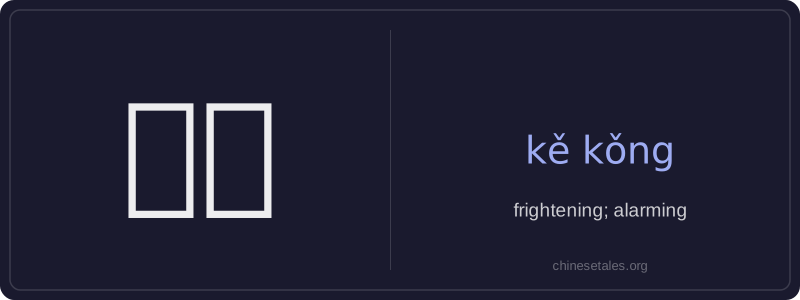
可恐 (kě kǒng) is an adjective meaning 'frightening' or 'alarming', often used to describe situations, events, or phenomena that provoke fear or serious concern. The character 可 (kě) here functions as a modal particle meaning 'can be' or 'is liable to be', while 恐 (kǒng) means 'fear' or 'dread'. Together, they form a compact, literary expression conveying that something is objectively capable of causing fear—not merely subjectively scary, but genuinely threatening or disturbing.
This term appears more frequently in formal writing, news reports, academic discussions, or solemn speech than in casual conversation. It carries a tone of gravity and objectivity—often implying danger, risk, or urgency—making it suitable for describing natural disasters, public health crises, or social instability. Unlike colloquial terms like 害怕 (hài pà, 'to be afraid') or 吓人 (xià rén, 'scary'), 可恐 emphasizes the inherent alarming quality of the subject itself rather than the speaker’s emotional reaction.
Example Sentences
Related Words
面条
‘面条’ (miàn tiáo) literally means ‘flour str
背后
背后 literally means 'back + behind' and functions
认同
‘认同’ (tóng rèn) is a verb meaning ‘to ident
无论谁
‘无论谁’ (wú lùn shéi) is a pronoun meaning
中学
'Zhōngxué' literally combines 'zhōng' (middle)
见面
见面 literally means 'see face' — combining 见 (t
外语
‘外语’ literally means ‘outside language’ —
认为
‘认为’ (rèn wéi) is a transitive verb meaning