Word Explanation
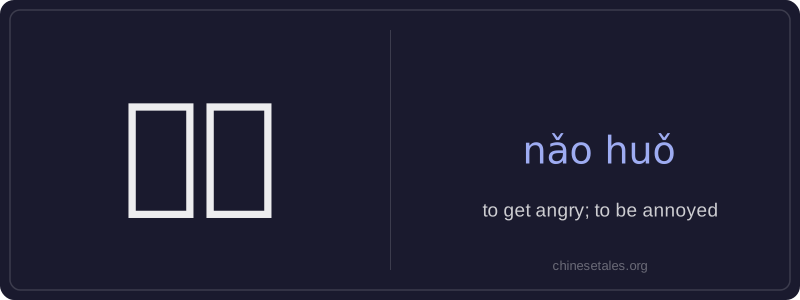
‘恼火’ is a verb meaning ‘to get angry’ or ‘to be annoyed’, often describing a sudden, sharp irritation—like a small flame flaring up. The first character 恼 (nǎo) means ‘to feel distressed or vexed’, while 火 (huǒ) literally means ‘fire’, evoking heat, intensity, and loss of calm. Together, they form an idiomatic compound that conveys emotional heat rather than physical fire—it’s not about combustion, but about inner frustration bubbling to the surface.
This word is commonly used in informal spoken and written Chinese, especially when someone reacts strongly to minor inconveniences: slow service, repeated mistakes, or unreasonable demands. It’s stronger than 生气 (shēngqì, ‘to get angry’) in tone but less severe than 狂怒 (kuángnù, ‘furious rage’). Native speakers often use it with subjects like ‘我’ (I), ‘他’ (he), or impersonal constructions like ‘真恼火!’ (‘So annoying!’) to express exasperation without full-blown anger.
Example Sentences
Related Words
面条
‘面条’ (miàn tiáo) literally means ‘flour str
背后
背后 literally means 'back + behind' and functions
认同
‘认同’ (tóng rèn) is a verb meaning ‘to ident
无论谁
‘无论谁’ (wú lùn shéi) is a pronoun meaning
中学
'Zhōngxué' literally combines 'zhōng' (middle)
见面
见面 literally means 'see face' — combining 见 (t
外语
‘外语’ literally means ‘outside language’ —
认为
‘认为’ (rèn wéi) is a transitive verb meaning