Word Explanation
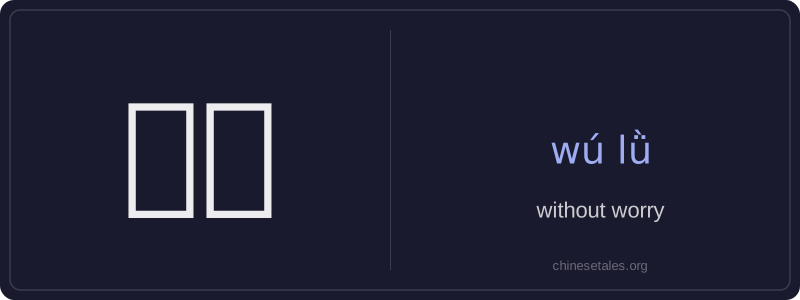
'Wú lǜ' literally means 'without worry' — combining 无 (wú), meaning 'without' or 'not having', and 虑 (lǜ), meaning 'concern', 'anxiety', or 'forethought'. Together, they form a classical, literary adjective describing a state of calm assurance, free from mental distress or apprehension. Though grammatically adjectival, it functions more like a fixed descriptive phrase and is rarely used predicatively without support (e.g., not *'He is wú lǜ'*, but rather 'a wú lǜ life' or 'live wú lǜ').
This term appears frequently in formal writing, idioms (e.g., 无忧无虑 wú yōu wú lǜ — 'free from both sorrow and worry'), and poetic or reflective contexts. It conveys deep tranquility, often implying security, simplicity, or innocence — such as a child’s carefree spirit or an idealized natural setting untouched by human stress. While understood by all native speakers, it sounds elevated or slightly archaic in everyday speech, where simpler alternatives like 没担心 (méi dānxīn) are preferred.
Example Sentences
Related Words
面条
‘面条’ (miàn tiáo) literally means ‘flour str
背后
背后 literally means 'back + behind' and functions
认同
‘认同’ (tóng rèn) is a verb meaning ‘to ident
无论谁
‘无论谁’ (wú lùn shéi) is a pronoun meaning
中学
'Zhōngxué' literally combines 'zhōng' (middle)
见面
见面 literally means 'see face' — combining 见 (t
外语
‘外语’ literally means ‘outside language’ —
认为
‘认为’ (rèn wéi) is a transitive verb meaning