Word Explanation
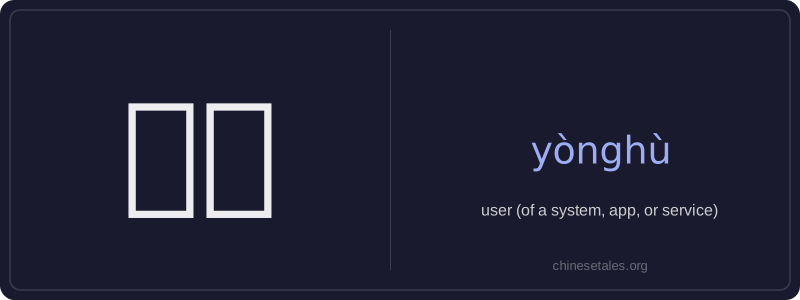
用户 (yònghù) literally combines 用 (yòng, 'to use') and 户 (hù, 'household' or 'family unit'), originally referring to a household that uses a service. In modern Chinese, it exclusively means 'user' — specifically a person who uses a digital system, app, website, or technical service. It is a formal, neutral term widely used in tech, business, and customer service contexts, and rarely appears in casual speech about people in non-digital settings.
The word functions as a noun and typically appears after classifiers like 一 (yī) or quantifiers like 所有 (suǒyǒu). It often co-occurs with verbs like 注册 (zhùcè, 'to register'), 登录 (dēnglù, 'to log in'), or 删除 (shānchú, 'to delete'). Unlike English 'user', 用户 carries no negative connotation (e.g., not implying addiction or passive consumption) and is never used for animals or non-human entities — it always refers to human individuals interacting intentionally with a system.
Example Sentences
Related Words
面条
‘面条’ (miàn tiáo) literally means ‘flour str
背后
背后 literally means 'back + behind' and functions
认同
‘认同’ (tóng rèn) is a verb meaning ‘to ident
无论谁
‘无论谁’ (wú lùn shéi) is a pronoun meaning
中学
'Zhōngxué' literally combines 'zhōng' (middle)
见面
见面 literally means 'see face' — combining 见 (t
外语
‘外语’ literally means ‘outside language’ —
认为
‘认为’ (rèn wéi) is a transitive verb meaning