Word Explanation
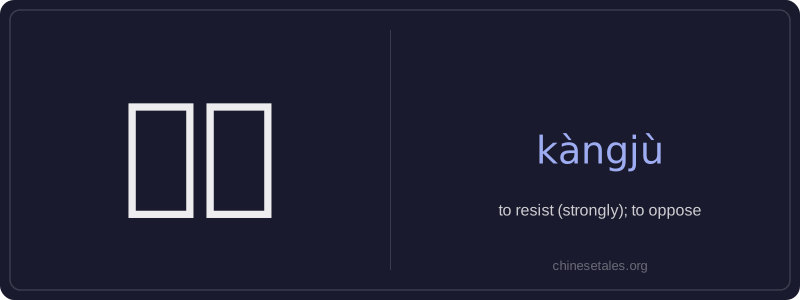
抗拒 (kàngjù) is a verb meaning 'to resist strongly' or 'to oppose actively,' often implying emotional, psychological, or physical resistance against something unwanted, such as medical treatment, authority, change, or internal urges. The first character 抗 (kàng) means 'to resist' or 'to oppose,' while 拒 (jù) means 'to refuse' or 'to reject'; together they form a compound emphasizing firm, determined opposition—not passive disagreement but active resistance.
This word commonly appears in contexts involving health (e.g., resisting therapy), psychology (e.g., resisting impulses), education (e.g., refusing to follow rules), or social situations (e.g., rejecting advice). It carries a slightly formal or literary tone and is stronger than simple verbs like 拒绝 (jùjué, 'to refuse')—it suggests inner struggle or defiance. It’s frequently used with objects like 治疗 (zhìliáo, 'treatment'), 命令 (mìnglìng, 'orders'), or 改变 (gǎibiàn, 'change').
Example Sentences
Related Words
国语
‘Guó yǔ’ literally means 'national language'—
面条
‘面条’ (miàn tiáo) literally means ‘flour str
背后
背后 literally means 'back + behind' and functions
认同
‘认同’ (tóng rèn) is a verb meaning ‘to ident
无论谁
‘无论谁’ (wú lùn shéi) is a pronoun meaning
中学
'Zhōngxué' literally combines 'zhōng' (middle)
见面
见面 literally means 'see face' — combining 见 (t
外语
‘外语’ literally means ‘outside language’ —