Word Explanation
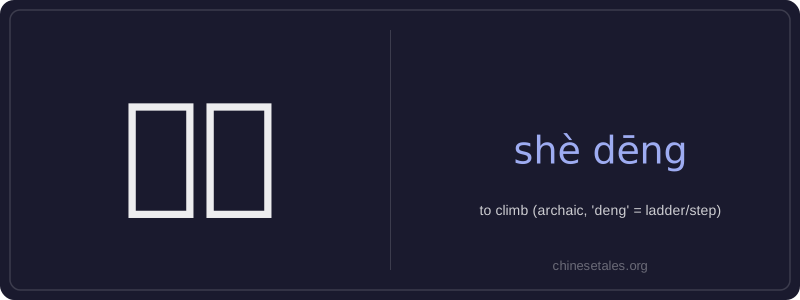
‘拾蹬’ is an archaic literary verb meaning 'to climb'—especially by stepping upward on a ladder, stair, or steep terrain. The character 拾 (shè) here is a classical reading meaning 'to ascend step by step', distinct from its common modern reading shí ('to pick up'). The character 蹬 (dēng) means 'to step on' or 'to push off with the foot', reinforcing the physical act of climbing. Together, they evoke a deliberate, effortful ascent, often used in classical poetry, historical narratives, or stylized prose.
This term is rarely heard in spoken Mandarin today and appears mainly in literary or rhetorical contexts—such as describing someone scaling a mountain, mounting a horse, or ascending a watchtower. It carries a formal, slightly solemn tone and may appear in idiomatic expressions or fixed phrases like 拾蹬而上 ('climb upward step by step'). Learners should recognize it as a set phrase, not a productive compound: the characters do not combine freely with other words in modern usage.
Example Sentences
Related Words
国语
‘Guó yǔ’ literally means 'national language'—
面条
‘面条’ (miàn tiáo) literally means ‘flour str
背后
背后 literally means 'back + behind' and functions
认同
‘认同’ (tóng rèn) is a verb meaning ‘to ident
无论谁
‘无论谁’ (wú lùn shéi) is a pronoun meaning
中学
'Zhōngxué' literally combines 'zhōng' (middle)
见面
见面 literally means 'see face' — combining 见 (t
外语
‘外语’ literally means ‘outside language’ —