Word Explanation
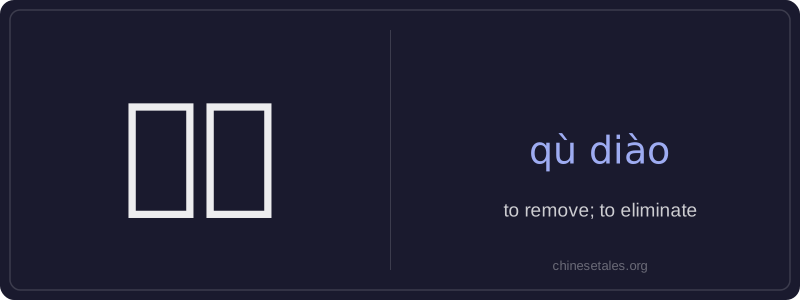
去掉 (qù diào) is a transitive verb meaning 'to remove' or 'to eliminate' something physically, visually, or abstractly — such as deleting text, taking off clothing, erasing data, or eliminating an unwanted element. The first character 去 means 'to go' or 'to leave', suggesting movement away; the second character 掉 means 'to fall off' or 'to drop', implying loss or separation. Together, they form a compound that emphasizes complete removal — not just moving something aside, but getting rid of it entirely. It’s commonly used in everyday speech and writing, especially when referring to deliberate, intentional removal.
This verb requires a direct object (e.g., 去掉标签, 去掉错误), and often appears in instructions, editing contexts, cooking steps, or problem-solving language. Unlike some synonyms, 去掉 implies finality: once something is 去掉, it’s no longer present or active. It’s neutral in register — appropriate in both casual conversation and formal documentation — and frequently pairs with measure words like '了' (qù diào le) to indicate completion.
Example Sentences
Related Words
国语
‘Guó yǔ’ literally means 'national language'—
面条
‘面条’ (miàn tiáo) literally means ‘flour str
背后
背后 literally means 'back + behind' and functions
认同
‘认同’ (tóng rèn) is a verb meaning ‘to ident
无论谁
‘无论谁’ (wú lùn shéi) is a pronoun meaning
中学
'Zhōngxué' literally combines 'zhōng' (middle)
见面
见面 literally means 'see face' — combining 见 (t
外语
‘外语’ literally means ‘outside language’ —