Word Explanation
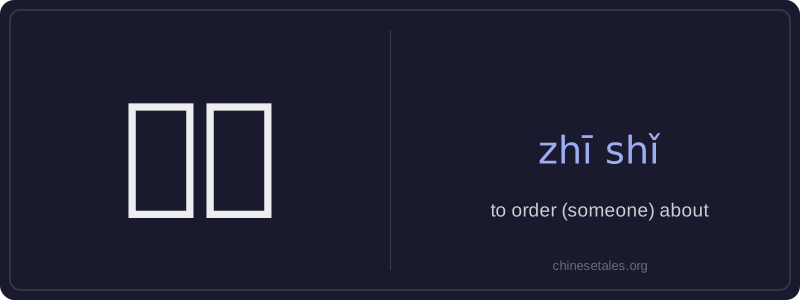
‘支使’ is a verb meaning to order someone around, usually in a casual, somewhat dismissive or unbalanced way — often implying the speaker has authority (real or assumed) and treats the other person as a tool for their convenience. The first character ‘支’ (zhī) originally means ‘to support’ or ‘to dispatch’, and here conveys the idea of directing or sending someone off to do something; the second character ‘使’ (shǐ) means ‘to use’ or ‘to employ’. Together, they form a compound that emphasizes using another person instrumentally, rather than collaborating or requesting politely.
This word carries a mild negative connotation: it suggests imbalance in power or respect, and is commonly used in family, workplace, or service contexts — for example, a boss assigning menial tasks without consideration, or a sibling constantly asking a younger brother to run errands. It’s rarely used in formal writing but frequent in spoken Chinese, especially when expressing annoyance or describing unfair dynamics.
Example Sentences
Related Words
国语
‘Guó yǔ’ literally means 'national language'—
面条
‘面条’ (miàn tiáo) literally means ‘flour str
背后
背后 literally means 'back + behind' and functions
认同
‘认同’ (tóng rèn) is a verb meaning ‘to ident
无论谁
‘无论谁’ (wú lùn shéi) is a pronoun meaning
中学
'Zhōngxué' literally combines 'zhōng' (middle)
见面
见面 literally means 'see face' — combining 见 (t
外语
‘外语’ literally means ‘outside language’ —