Word Explanation
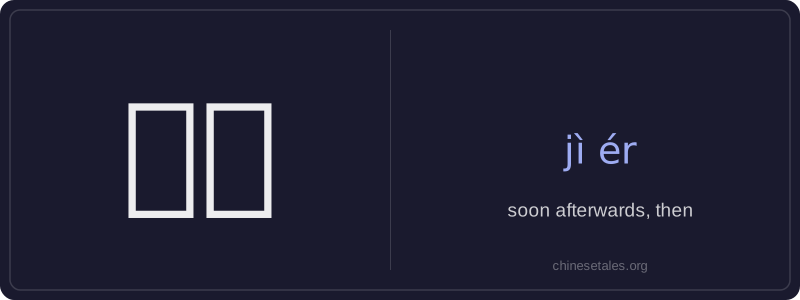
‘既而’ is a classical Chinese adverb meaning ‘soon afterwards’ or ‘then’, indicating a short passage of time between two events. The character 既 (jì) originally means ‘already’ or ‘since’, conveying completion or a point in time that has been reached; 而 (ér) functions here as a conjunction meaning ‘and then’ or ‘but’, linking sequential actions. Together, they form a compact temporal connector used to show immediate succession—similar to ‘shortly after that’ or ‘not long thereafter’. It is more formal and literary than everyday alternatives like 然后 or 接着, and appears frequently in written narratives, historical texts, and formal speeches.
This term is rarely used in casual spoken Chinese and is generally avoided in beginner-level conversation. It often introduces the second clause in a two-part sequence where the first action sets the stage for the second. While it resembles modern time adverbs, its tone is slightly elevated and concise, making it especially common in storytelling, news reports, and academic writing where precision and stylistic economy are valued.
Example Sentences
Related Words
国语
‘Guó yǔ’ literally means 'national language'—
面条
‘面条’ (miàn tiáo) literally means ‘flour str
背后
背后 literally means 'back + behind' and functions
认同
‘认同’ (tóng rèn) is a verb meaning ‘to ident
无论谁
‘无论谁’ (wú lùn shéi) is a pronoun meaning
中学
'Zhōngxué' literally combines 'zhōng' (middle)
见面
见面 literally means 'see face' — combining 见 (t
外语
‘外语’ literally means ‘outside language’ —