Word Explanation
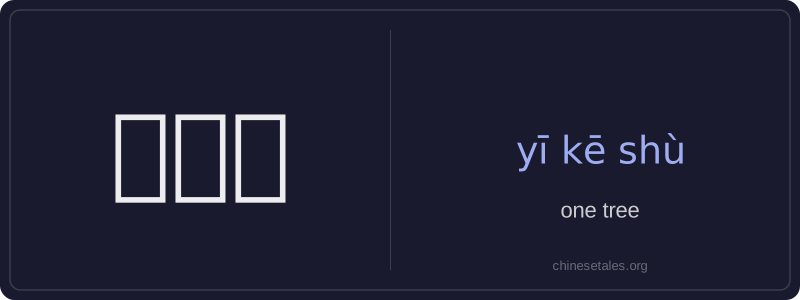
‘一棵树’ literally means ‘one tree’ and functions as a noun phrase indicating a single, countable tree. The character ‘一’ (yī) is the numeral ‘one’, ‘棵’ (kē) is a measure word used specifically for trees, shrubs, and some tall, rooted plants (like bamboo or banana plants), and ‘树’ (shù) means ‘tree’. Unlike English, Mandarin requires a classifier—here ‘棵’—between numerals and nouns for most countable objects; you cannot say ‘一树’ alone. This phrase is commonly used in descriptions of landscapes, environmental contexts, or everyday observations.
It appears in both spoken and written Chinese, from casual conversation to formal writing about ecology or urban planning. While ‘棵’ is not used for all plants (e.g., flowers use ‘朵’, grass uses ‘株’), it’s essential for trees—and always paired with ‘树’ when counting individual specimens. The phrase emphasizes singularity and concreteness, often evoking imagery of solitude, growth, or natural presence.
Example Sentences
Related Words
国语
‘Guó yǔ’ literally means 'national language'—
面条
‘面条’ (miàn tiáo) literally means ‘flour str
背后
背后 literally means 'back + behind' and functions
认同
‘认同’ (tóng rèn) is a verb meaning ‘to ident
无论谁
‘无论谁’ (wú lùn shéi) is a pronoun meaning
中学
'Zhōngxué' literally combines 'zhōng' (middle)
见面
见面 literally means 'see face' — combining 见 (t
外语
‘外语’ literally means ‘outside language’ —