Word Explanation
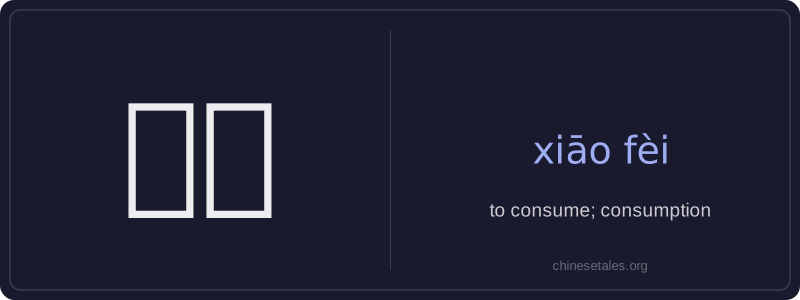
消费 means 'to consume' (as a verb) or 'consumption' (as a noun), especially in economic, commercial, or daily-life contexts. It combines 消 (xiāo), meaning 'to use up' or 'to eliminate', and 费 (fèi), meaning 'expense' or 'cost'. Together, they convey the idea of using up resources—typically money or goods—in exchange for services or products. This word is neutral and formal, commonly used in news reports, policy discussions, and everyday conversation about spending habits.
Unlike general terms like 吃 (chī, 'to eat') or 用 (yòng, 'to use'), 消费 emphasizes the transactional or economic aspect: you're not just using something—you're expending value, often money. It appears frequently in phrases like 消费水平 (xiāo fèi shuǐ píng, 'consumption level'), 消费者 (xiāo fèi zhě, 'consumer'), and 鼓励消费 (gǔ lì xiāo fèi, 'to encourage consumption'). It rarely refers to biological consumption (e.g., animals eating food) unless metaphorically or in technical economic discourse.
Example Sentences
Related Words
国语
‘Guó yǔ’ literally means 'national language'—
面条
‘面条’ (miàn tiáo) literally means ‘flour str
无论谁
‘无论谁’ (wú lùn shéi) is a pronoun meaning
背后
背后 literally means 'back + behind' and functions
外语
‘外语’ literally means ‘outside language’ —
认同
‘认同’ (tóng rèn) is a verb meaning ‘to ident
中学
'Zhōngxué' literally combines 'zhōng' (middle)
见面
见面 literally means 'see face' — combining 见 (t