Word Explanation
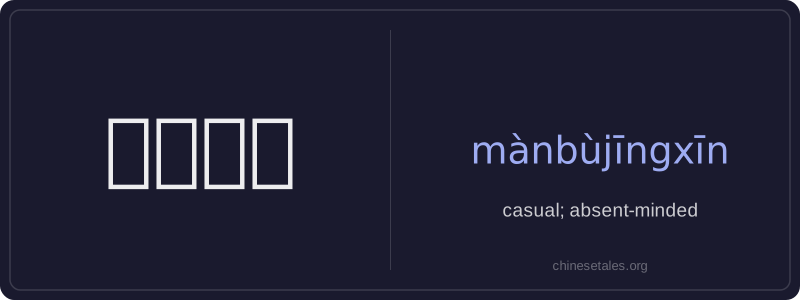
‘漫不经心’ describes a mental state of casual indifference or absent-mindedness — doing something without real attention, care, or intention. Literally, ‘漫’ means ‘casual’ or ‘unrestrained’, ‘不’ is the negation particle, ‘经’ means ‘to go through’ or ‘to attend to’, and ‘心’ means ‘heart/mind’. Together, the phrase evokes the image of letting things pass by the mind without engagement — as if one’s thoughts are wandering while outwardly performing a task.
This adjective is commonly used to describe behavior in everyday situations: someone flipping through a book without reading, listening to instructions while daydreaming, or replying to a question with a distracted shrug. It often carries a slightly negative or critical nuance — implying negligence, lack of seriousness, or emotional detachment — though context can soften this (e.g., in describing gentle, dreamy absentmindedness). It functions predicatively (e.g., ‘他显得漫不经心’) or attributively before nouns (e.g., ‘漫不经心的态度’), but rarely as a standalone noun or verb.
Example Sentences
Related Words
国语
‘Guó yǔ’ literally means 'national language'—
面条
‘面条’ (miàn tiáo) literally means ‘flour str
无论谁
‘无论谁’ (wú lùn shéi) is a pronoun meaning
背后
背后 literally means 'back + behind' and functions
外语
‘外语’ literally means ‘outside language’ —
认同
‘认同’ (tóng rèn) is a verb meaning ‘to ident
中学
'Zhōngxué' literally combines 'zhōng' (middle)
见面
见面 literally means 'see face' — combining 见 (t