Word Explanation
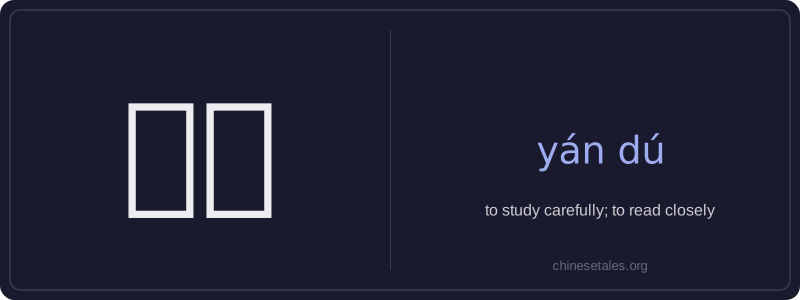
研读 is a formal, literary verb meaning 'to study carefully' or 'to read closely and analytically.' It combines 研 (yán), meaning 'to research,' 'to examine thoroughly,' or 'to refine,' and 读 (dú), meaning 'to read.' Together, they convey a deeper, more deliberate form of reading—one that involves critical thinking, reflection, and often scholarly engagement. Unlike casual reading (看 kàn) or general studying (学习 xuéxí), 研读 implies sustained attention to detail, interpretation of meaning, and sometimes textual analysis.
This term is commonly used in academic, professional, or intellectual contexts—such as reading classical texts, legal documents, scientific papers, or literary works. It appears frequently in university settings, research instructions, and formal writing. While grammatically it functions as a transitive verb (requiring an object), it is rarely used in everyday spoken Chinese and carries a serious, respectful tone. Learners should avoid using it for light or recreational reading.
Example Sentences
Related Words
国语
‘Guó yǔ’ literally means 'national language'—
面条
‘面条’ (miàn tiáo) literally means ‘flour str
无论谁
‘无论谁’ (wú lùn shéi) is a pronoun meaning
背后
背后 literally means 'back + behind' and functions
外语
‘外语’ literally means ‘outside language’ —
认同
‘认同’ (tóng rèn) is a verb meaning ‘to ident
中学
'Zhōngxué' literally combines 'zhōng' (middle)
见面
见面 literally means 'see face' — combining 见 (t