Word Explanation
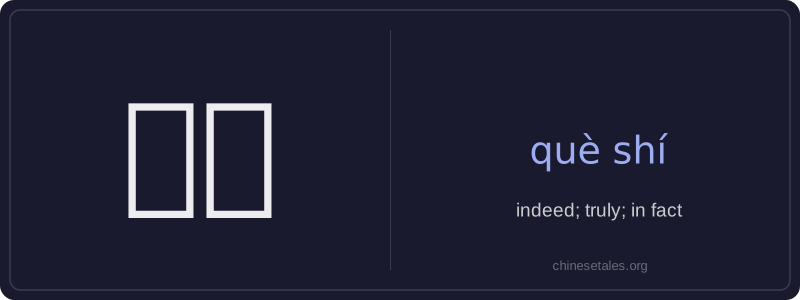
确实 is an adverb meaning 'indeed', 'truly', or 'in fact'. It emphasizes the truth or certainty of a statement, often used to confirm something previously mentioned or to express strong agreement. The character 确 means 'certain' or 'definite', and 实 means 'real' or 'actual'; together, they reinforce authenticity and factual accuracy. It frequently appears in spoken and written Chinese to add weight to assertions, especially in conversations where clarification or validation is needed.
This word is neutral in register—appropriate in both informal chats and formal writing—but is rarely used alone as a response; instead, it modifies verbs, adjectives, or whole clauses. It commonly follows subject–predicate structures (e.g., 他确实很努力) and can appear at the beginning, middle, or end of a sentence depending on emphasis. Unlike modal verbs or particles, 确实 doesn’t change form and never takes aspect markers like 了 or 过.
Example Sentences
Related Words
国语
‘Guó yǔ’ literally means 'national language'—
面条
‘面条’ (miàn tiáo) literally means ‘flour str
无论谁
‘无论谁’ (wú lùn shéi) is a pronoun meaning
背后
背后 literally means 'back + behind' and functions
外语
‘外语’ literally means ‘outside language’ —
认同
‘认同’ (tóng rèn) is a verb meaning ‘to ident
中学
'Zhōngxué' literally combines 'zhōng' (middle)
见面
见面 literally means 'see face' — combining 见 (t