Word Explanation
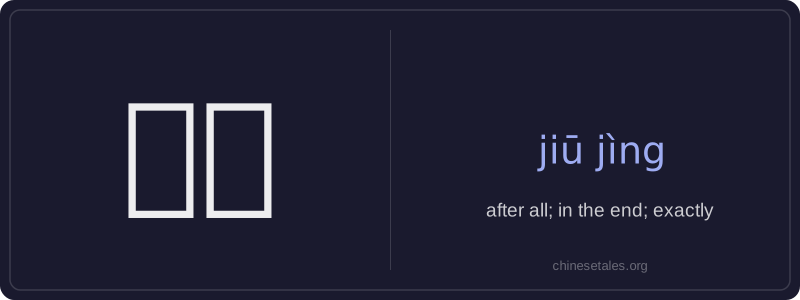
究竟 is an adverb meaning 'after all', 'in the end', or 'exactly'—it adds emphasis to a question or statement, often expressing impatience, curiosity, or insistence on clarity. Though composed of two characters (究 meaning 'to investigate' and 竟 meaning 'to finish' or 'finally'), together they function as a fixed, inseparable unit with a rhetorical force. It frequently appears in questions (e.g., '究竟为什么?') to press for a definitive answer, or in assertions (e.g., '他究竟来了') to stress factual certainty despite doubt or delay.
The word carries a slightly formal or literary tone and is common in both spoken and written Mandarin, especially when the speaker seeks resolution or challenges ambiguity. It is never used as a noun or verb; its placement is typically before verbs or adjectives, and it cannot be modified or split. Unlike simpler question words like 为什么 or 怎么, 究竟 injects urgency or skepticism, implying that previous explanations have been insufficient or evasive.
Example Sentences
Related Words
国语
‘Guó yǔ’ literally means 'national language'—
面条
‘面条’ (miàn tiáo) literally means ‘flour str
认同
‘认同’ (tóng rèn) is a verb meaning ‘to ident
无论谁
‘无论谁’ (wú lùn shéi) is a pronoun meaning
背后
背后 literally means 'back + behind' and functions
外语
‘外语’ literally means ‘outside language’ —
认为
‘认为’ (rèn wéi) is a transitive verb meaning
中学
'Zhōngxué' literally combines 'zhōng' (middle)