Word Explanation
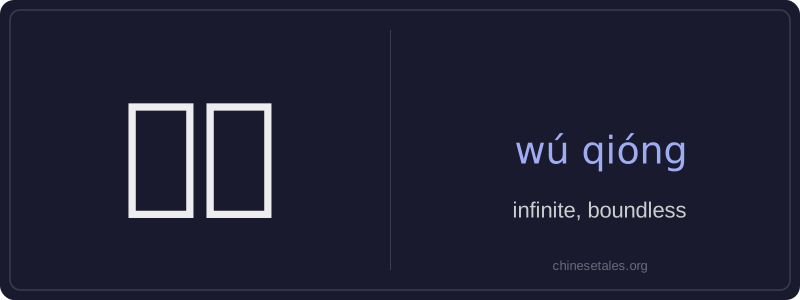
‘无穷’ literally means 'without end' — ‘无’ (wú) means 'not' or 'without', and ‘穷’ (qióng) means 'end', 'limit', or 'exhaustion'. Together, they form a compound adjective meaning 'infinite', 'boundless', or 'endless'. It emphasizes the absence of any boundary, whether in quantity, time, space, or potential. It is commonly used in formal, literary, or abstract contexts — for example, when describing vast natural phenomena, mathematical concepts, or profound emotions.
Unlike colloquial expressions like ‘很多很多’ (very many), ‘无穷’ carries a tone of grandeur or philosophical weight. It often appears in written language, idioms (e.g., 无穷无尽), scientific discourse, or poetic descriptions. While it can modify nouns directly (e.g., 无穷的力量), it’s rarely used predicatively without additional structure (e.g., 不是无穷的 is acceptable, but *它很无穷 is ungrammatical — use 无穷无尽的 or extremely boundless instead).
Example Sentences
Related Words
国语
‘Guó yǔ’ literally means 'national language'—
面条
‘面条’ (miàn tiáo) literally means ‘flour str
外语
‘外语’ literally means ‘outside language’ —
认同
‘认同’ (tóng rèn) is a verb meaning ‘to ident
无论谁
‘无论谁’ (wú lùn shéi) is a pronoun meaning
背后
背后 literally means 'back + behind' and functions
认为
‘认为’ (rèn wéi) is a transitive verb meaning
不对
不对 (bù duì) literally combines 不 (bù), meani