Word Explanation
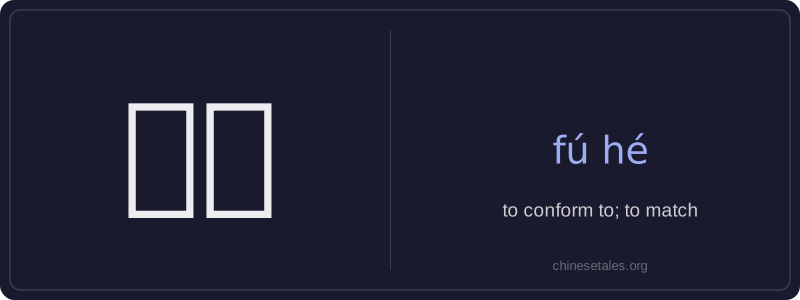
符合 is a verb meaning 'to conform to', 'to match', or 'to be consistent with' something — typically a standard, requirement, expectation, rule, or condition. The character 符 (fú) originally meant 'tally' or 'token', implying correspondence or agreement; 合 (hé) means 'to join', 'to fit together', or 'to be in harmony'. Together, they convey the idea of two things aligning precisely — like pieces fitting together perfectly. It’s commonly used in formal, written, or professional contexts: regulations, test results, specifications, logical reasoning, or subjective judgments about appropriateness.
This word emphasizes objective compatibility rather than personal preference. It often appears after a subject and before a noun phrase introduced by 的 or a clause introduced by 与…一致 or 于. While it can describe physical resemblance (e.g., matching a description), its core function is verifying alignment with an external benchmark — not just similarity, but correctness or validity according to criteria.
Example Sentences
Related Words
国语
‘Guó yǔ’ literally means 'national language'—
面条
‘面条’ (miàn tiáo) literally means ‘flour str
无论谁
‘无论谁’ (wú lùn shéi) is a pronoun meaning
外语
‘外语’ literally means ‘outside language’ —
认同
‘认同’ (tóng rèn) is a verb meaning ‘to ident
背后
背后 literally means 'back + behind' and functions
认为
‘认为’ (rèn wéi) is a transitive verb meaning
不对
不对 (bù duì) literally combines 不 (bù), meani