中
Character Story & Explanation
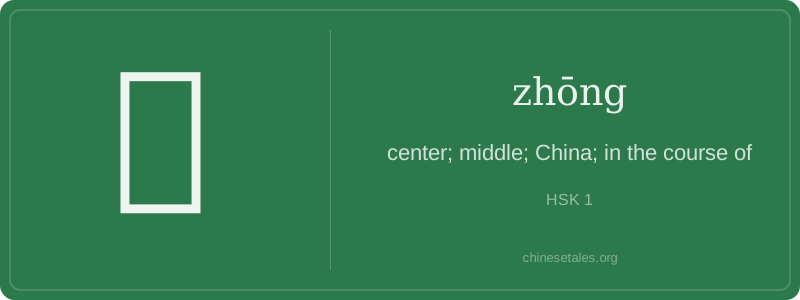
The earliest form of 中 appears on Shāng dynasty oracle bones (c. 1200 BCE) as a vertical line — 丨 — piercing a rectangular banner or flagpole marker. Imagine a tall pole planted firmly in the ground, with cloth fluttering symmetrically left and right: the vertical stroke wasn’t just ‘a line’ — it was the *axis* around which order formed. Over centuries, the flanking banners simplified into two short horizontal strokes (one top, one bottom), while the central pole remained bold and unbroken — giving us today’s clean, symmetrical 四-stroke 中. Its visual perfection wasn’t accidental: symmetry signaled correctness, stability, and cosmic alignment.
This visual logic shaped its meaning. In the *Book of Rites*, ‘zhōng’ described ritual precision — hitting the exact moral and ceremonial center. By the Han dynasty, it anchored the concept of Zhōngguó: not ‘central land’ on a map, but the culturally luminous heart where virtue radiated outward. Even today, the character’s unbroken vertical stroke embodies resilience — no matter how much the world shifts left or right, 中 stands upright, centered, and unwavering.
At its heart, 中 isn’t just ‘center’ — it’s the Chinese cultural heartbeat. Think of it as the still point in a spinning world: the balanced axis of a wheel, the quiet core of a storm, the moral center Confucius called ‘zhōng yōng’ (the Doctrine of the Mean). Unlike English ‘middle’, which is often spatial and neutral, 中 carries weight — harmony, legitimacy, and resonance. That’s why China calls itself Zhōngguó (‘Middle Kingdom’): not geographically arrogant, but philosophically rooted — the civilization where Heaven, Earth, and Humanity meet.
Grammatically, 中 shines in two HSK 1 roles: as a noun meaning ‘center/middle’ (e.g., ‘zài zhōngjiān’ — ‘in the middle’), and as a location word after prepositions like zài (‘at/in’). Crucially, it *never* stands alone as an adverb like ‘centrally’ — you’ll never say ‘tā zhōng zuò’; instead, it’s always embedded: ‘tā zuò zài zhōngjiān’. Learners often overgeneralize and drop the particle, creating unnatural sentences. Also, watch tone: zhōng (level tone) = center; zhòng (falling-rising) = ‘to hit the target’ or ‘to be affected’ — same character, totally different semantic universe.
Culturally, 中 appears everywhere — from ‘zhōngyī’ (Traditional Chinese Medicine, literally ‘Chinese medicine’) to ‘zhōngqiū jié’ (Mid-Autumn Festival, celebrating balance and reunion). A common mistake? Using 中 for ‘during’ without context: ‘in the course of’ requires structure like ‘zài…zhōng’ (e.g., zài xuéxí zhōng — ‘while studying’). Without the preposition frame, 中 feels naked and incomplete — like trying to serve soup without a bowl.