醒
Character Story & Explanation
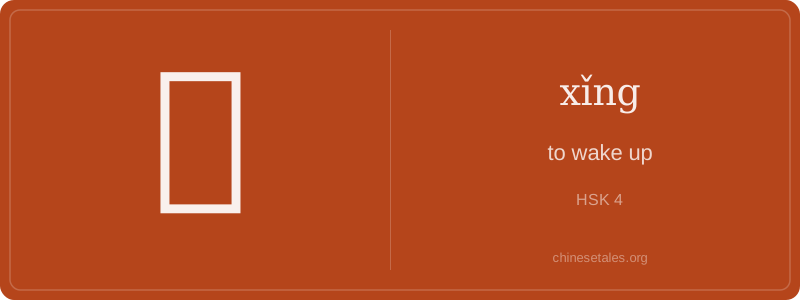
The earliest form of 醒 appears in Warring States bamboo slips — not as a pictograph, but as a semantic-phonetic compound. Its left side 酉 (yǒu), the ‘wine vessel’ radical, hints at its ancient link to sobriety: originally, 醒 meant ‘to sober up’ — the moment alcohol’s haze lifts and reason returns. The right side, 星 (xīng, ‘star’), served as the phonetic clue (both share the -ǐng/-īng sound). Over centuries, strokes standardized: the wine vessel kept its three horizontal lines and curved base; 星 evolved from star-shaped dots into the modern ‘sun + life’ structure — though here, it’s purely phonetic, not celestial.
By the Han dynasty, 醒 expanded beyond sobriety to mean ‘to awaken’ physically and mentally — appearing in texts like the *Huainanzi*, where ‘心醒’ (xīn xǐng) describes the mind emerging from confusion like dawn breaking. Its visual logic remains elegant: a vessel (酉) grounding the process in bodily reality, paired with a ‘star’ (星) suggesting sudden illumination — as if consciousness itself is a light piercing darkness. Even today, when Chinese say ‘我醒了’, they’re not just reporting eye movement — they’re declaring a return to self.
At its heart, 醒 (xǐng) isn’t just ‘to wake up’ — it’s the moment consciousness pierces through fog: eyes snapping open, mind clearing, awareness returning *from within*. Unlike 睡 (shuì, ‘to sleep’) or 起 (qǐ, ‘to get up’), 醒 emphasizes the internal shift — the dawning of clarity. That’s why it extends naturally to metaphorical awakening: ‘to realize’, ‘to become aware’, or even ‘to sober up’ after drinking. You’ll hear it in phrases like ‘醒悟’ (xǐngwù, ‘to awaken to the truth’) — not just physical wakefulness, but intellectual or moral clarity.
Grammatically, 醒 is an intransitive verb that often appears with complements like 了 (le) for completed action (他醒了 — Tā xǐng le — ‘He woke up’) or 在 (zài) for ongoing state (他在醒 — less common; better: 他正在醒来 — Tā zhèngzài xǐng lái). Learners sometimes wrongly use it transitively (*‘I wake him up’ → *我醒他*), but the causative form requires 叫 (jiào) or 弄 (nòng): 我叫他醒了 (Wǒ jiào tā xǐng le). Also note: it’s almost never used for alarm clocks — we say 闹钟响了 (nàozhōng xiǎng le), not *闹钟醒了*!
Culturally, 醒 carries quiet weight — think of Lu Xun’s famous line: ‘其实地上本没有路,走的人多了,也便成了路’ — his entire project was to ‘wake China up’ (唤醒中国, huànxǐng Zhōngguó). It’s a character charged with responsibility and insight. A classic mistake? Confusing it with 星 (xīng, ‘star’) — same sound, totally different world: one stirs your mind, the other twinkles overhead.