阅
Character Story & Explanation
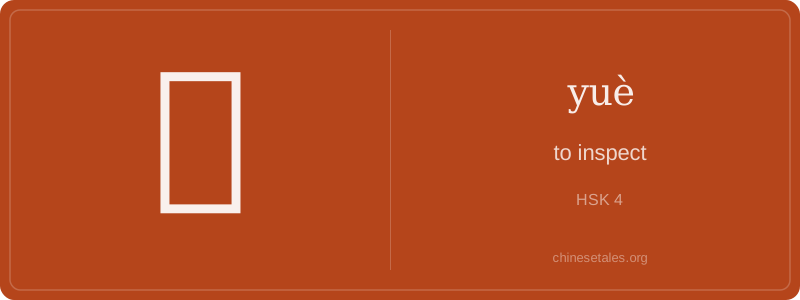
The earliest form of 阅 appears in bronze inscriptions as a door-shaped frame (门) enclosing a simplified figure holding a weapon or staff — likely depicting a gatekeeper or inspector standing watch at a city gate, verifying identities and permissions. Over time, the inner component evolved: the oracle bone version hinted at a kneeling person under surveillance; by the Han dynasty, it standardized into the current form — 门 (door radical) housing 兑 (duì), originally a pictograph of an open mouth or 'to exchange/verify', later phoneticized but retaining the sense of 'assessment through encounter'.
This door-as-gateway-to-authority metaphor deepened historically: in the Book of Rites, 阅 described military inspections where generals verified soldiers’ armor and weapons at camp gates. By the Tang dynasty, it extended to literary evaluation — scholars would 阅诗 (yuè shī, 'inspect poems') for imperial examinations. The door (门) isn’t passive; it’s the threshold across which legitimacy is granted — making 阅 less about eyes moving across text and more about judgment passing through a symbolic portal.
Think of 阅 (yuè) as the Chinese equivalent of a royal seal-stamp on an official document — not just 'reading', but *authoritative inspection*: scanning, verifying, and approving. It’s the verb you’d use when a general reviews troop formations, a teacher grades exams, or a customs officer checks passports. Unlike the casual ‘read’ (读 dú), 阅 implies scrutiny with purpose and authority — it’s the difference between skimming your email inbox and a forensic auditor reviewing every line of a tax return.
Grammatically, 阅 is often transitive and prefers formal or written objects: 阅卷 (yuè juàn, 'inspect exam papers'), 阅兵 (yuè bīng, 'review troops'), or 阅历 (yuè lì, 'life experience' — literally 'inspected history'). It rarely stands alone; you almost never say 'I yuè' without specifying *what* you’re inspecting. Learners mistakenly use it like 读 — saying *wǒ yuè shū* ('I inspect a book') sounds hilariously bureaucratic, like you’re auditing its plot for compliance.
Culturally, 阅 carries weight: in imperial China, only high officials could 阅奏折 (yuè zòuzhé, 'inspect memorials to the emperor'); today, journalists 阅稿 (yuè gǎo, 'review copy') before publication — a quiet act of gatekeeping. A common error? Confusing it with 易 (yì, 'easy') or 悦 (yuè, 'pleased') — same sound, totally different worlds. Remember: if it involves doors (门), scrutiny, and seriousness — it’s 阅.