饺
Character Story & Explanation
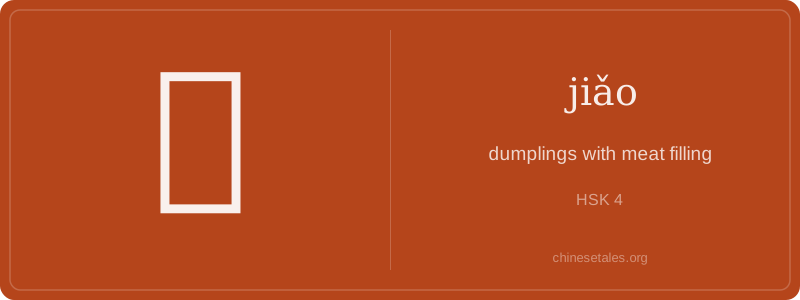
The earliest ancestor of 饺 isn’t found in oracle bones — it’s a relatively late creation, born during the Han dynasty or later, when wheat-based dumplings spread across northern China. Its modern form fuses two elements: the left side 饣 (shí), a simplified variant of 食 (food), and the right side 交 (jiāo), which originally depicted two crossed legs — symbolizing intersection, mutual exchange, or entwining. Over time, 交 evolved from a pictograph of crossed feet into a phonetic component, lending both sound (jiǎo) and subtle meaning: the folding action of wrapping filling inside dough, literally 'crossing' or 'joining' ingredients.
By the Song dynasty, 饺子 appears clearly in texts like Meng Yuanlao’s Dreams of Splendor of the Eastern Capital, describing street vendors selling boiled dumplings in Bianliang (Kaifeng). The character’s visual logic is elegant: 饣 tells you it’s edible; 交 hints at the craftsmanship — the crimped, interlocked edges that seal in flavor and fortune. No ancient sage carved this one in bone — it emerged from kitchens, not courts, making it a rare character born not from ritual, but from shared meals and folded dough.
Think of 饺 (jiǎo) as the cheerful, plump little cousin of the food radical 饣 — it’s not just any food, but specifically those delicious, hand-folded parcels of joy: dumplings. The character radiates warmth and celebration — you’ll rarely see it alone; it’s almost always part of a compound like 饺子 (jiǎo·zi), where 子 is a diminutive suffix that makes it feel cozy and familiar, like calling something 'dumpling-kins'. It’s a noun through and through — no verb forms, no adjectives — and it’s famously uncountable in Mandarin: you say 三个饺子 (sān gè jiǎo·zi), not *三饺. Learners often mistakenly treat 饺 as standalone (e.g., *我吃饺), forgetting it needs 子 to be natural.
Grammatically, 饺 only appears in fixed compounds — never solo in speech or writing. Even in menus or recipes, it’s always 饺子, 水饺, or 煎饺. You’ll never hear ‘a 饺’ — it’s like saying ‘a pizza’ in English without the -a. Also, note: 饺 is never used for non-meat fillings in traditional usage (tofu or veggie dumplings are still called 饺子, but contextually specified — e.g., 素饺子). This reflects how deeply tied the character is to its cultural core: meat-stuffed, crescent-shaped, labor-of-love food.
Culturally, 饺 isn’t just lunch — it’s Lunar New Year’s heartbeat. Families gather to fold them together, believing their shape echoes ancient silver ingots (yuanbao), inviting wealth. Mistake alert: Don’t confuse 饺 with other ‘food’ characters like 饭 (fàn, cooked rice) or 馒 (mán, steamed bun) — they’re different categories entirely. And yes, even though it has only 9 strokes, its meaning carries centuries of ritual, migration, and kitchen smoke.