饼
Character Story & Explanation
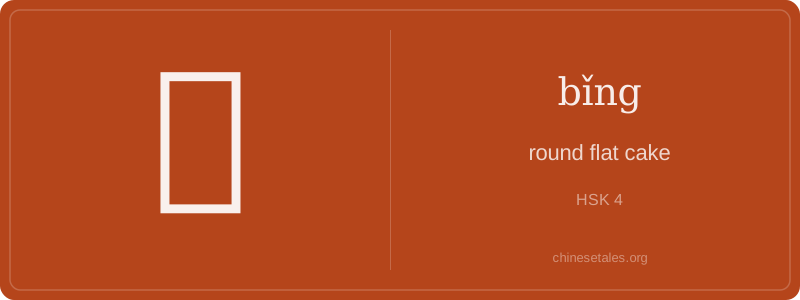
The earliest form of 饼 appears in Han-era clerical script—not oracle bone, but close enough in spirit. Its left side, 饣 (the food radical), evolved from the ancient character for 'food' (食), simplified over centuries into three tidy strokes resembling steam rising from a bowl. The right side, 并 (bìng), originally depicted two people standing side-by-side, symbolizing 'together' or 'in parallel'—a visual echo of flattening and layering. Over time, 并’s top stroke softened into the horizontal line, its two verticals became the double-dot and long stroke, and the lower crossbar fused into today’s clean 9-stroke form: food + flat unity.
This 'flat unity' idea shaped its meaning: by the Tang dynasty, 饼 explicitly meant grain-based food pressed thin and baked—think wheat-flour rounds cooked on griddles or in ovens. In the Classic of Poetry (Shījīng), '饼' doesn’t appear, but '餠' (an older variant) shows up in Han agricultural records describing 'millet cakes for travel'. The character’s visual symmetry mirrors its culinary function: balanced, portable, and designed to be shared—hence why mooncakes (月饼), inscribed with wishes, are literally 'moon bǐng': round tokens of harmony, not dessert.
Think of 饼 (bǐng) as China’s answer to the English word 'cake'—but with a crucial twist: it’s *always* round, flat, and baked or fried, never layered, frosted, or fluffy like Western birthday cake. It’s the linguistic cousin of 'pancake', 'cracker', or 'flatbread', but far more culturally elastic—encompassing everything from mooncakes (月饼) to savory scallion pancakes (葱油饼) and even industrial metal discs (steel bǐng). This isn’t just food—it’s geometry with flavor.
Grammatically, 饼 is a concrete noun that rarely stands alone; it almost always appears in compound words (like 蛋饼 or 烧饼) or with measure words: 一张饼 (yī zhāng bǐng, 'one sheet/cake'). Learners often mistakenly use it like 'cake' in English ('I ate cake'), but you’d *never* say '我吃了饼' without context or measure word—you’d say '我吃了一张饼' or specify the type. It also never means 'pie' (that’s 派), nor does it imply sweetness—many bǐng are savory, oily, or even spicy.
Culturally, bǐng carries ancient weight: during the Han dynasty, soldiers carried hardened millet bǐng as portable rations—essentially ancient energy bars. Today, calling something a 'bǐng' subtly signals its flatness and hand-held practicality. A common mistake? Assuming all round foods are bǐng—noodles (面) aren’t, dumplings (饺子) aren’t, and rice cakes (年糕) definitely aren’t, even if they’re roundish. Bǐng is about *intentional flatness*, not just shape.