养
Character Story & Explanation
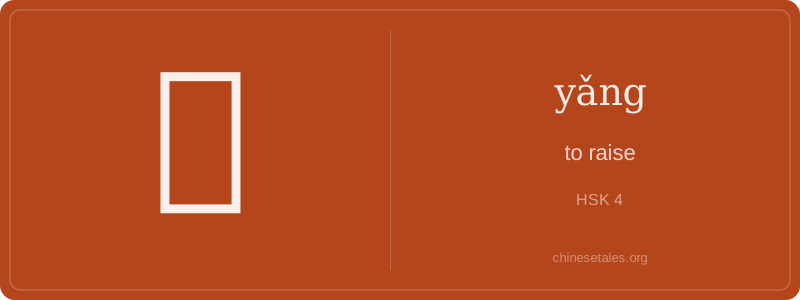
The earliest form of 养 appears in bronze inscriptions (c. 1000 BCE) as ⿱羊丷, depicting a sheep (羊) under a sheltering roof-like sign (丷, an ancient variant of 八, symbolizing separation or enclosure). The sheep wasn’t just livestock—it represented nourishment, sacrifice, and sustenance. Over centuries, the top evolved into 丷 (not 八!), and the bottom transformed from 羊’s full form into the simplified 羊 we see today—though crucially, the original pictograph emphasized containment and care: a protected, tended animal.
This visual logic shaped its semantic journey: from tending livestock (early Zhou texts) to nurturing people (Confucius’ Analects: ‘君子务本,本立而道生。孝弟也者,其为仁之本与!’ — ‘The root of benevolence lies in filial piety and fraternal respect’ — both rooted in 养). By the Han dynasty, 养 expanded to abstract domains: 养气 (‘cultivate vital energy’), 养德 (‘nurture virtue’), showing how Chinese thought sees moral and physical cultivation as one continuous act of careful tending.
Imagine a young couple in Chengdu, carefully feeding their newborn daughter with warm milk, then later teaching her to ride a bike—each moment steeped in quiet devotion. That’s 养 (yǎng) in action: not just ‘to raise’ like a farmer raises crops, but to nurture, sustain, and cultivate life over time—with patience, responsibility, and love. It carries emotional weight: you don’t just ‘feed’ a child; you 养 her, body and spirit.
Grammatically, 养 is versatile: it can be transitive (养狗 ‘raise a dog’) or intransitive (养病 ‘rest to recover’), and often appears in resultative compounds like 养好 (yǎng hǎo, ‘recover fully’) or 养成 (yǎng chéng, ‘cultivate a habit’). Learners often mistakenly use it where English says ‘keep’ or ‘have’—e.g., saying *养一个手机* instead of 有/用一个手机. Remember: 养 implies active, ongoing care—not passive possession.
Culturally, 养 is deeply tied to filial piety (孝 xiào) and intergenerational duty: 养父母 means ‘adoptive parents’, but also literally ‘parents who raised you’—highlighting that care flows both ways. A common slip? Using 养 instead of 教 (jiāo, ‘teach’) — you 养 a child, but 教 them math. And watch the tone: yǎng (third tone) is distinct from yáng (second tone, as in 阳), which means ‘sun/yang energy’—mixing them sounds like saying ‘I’m raising the sun’ instead of ‘raising my sister’.