餐
Character Story & Explanation
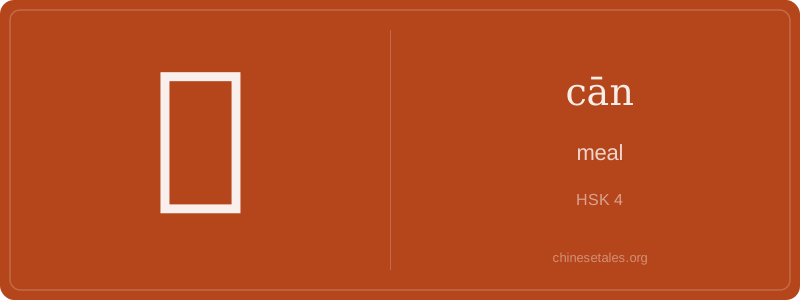
The earliest form of 餐 appears in bronze inscriptions around 800 BCE — not as a full character, but as part of the compound 飡 (an ancient variant). Its core was 食 (shí, ‘to eat’) on the left, and 又 (yòu, ‘again’ or ‘hand’) on the right, suggesting repeated action — perhaps hand-to-mouth motion or serving again and again. Over centuries, 又 evolved into the top-right component 16 (a stylized ‘hand’ + ‘knife’ shape), while the bottom-right became 3 (a simplified ‘rice’ or ‘grain’ element), merging into today’s elegant but abstract 16-stroke form. The radical 食 remains proudly front-and-center, anchoring it firmly in the realm of nourishment.
By the Han dynasty, 餐 had crystallized as a literary synonym for ‘meal’ — more refined than 飯 (fàn) and less ceremonial than 宴 (yàn). It appears in the classic Shuōwén Jiězì (121 CE) as ‘eating with care and respect’, underscoring its link to etiquette. In Tang poetry, Du Fu used 餐 in lines like ‘jī cān bù zhī wèi’ (‘I ate the meal but knew not its taste’), evoking distraction and sorrow — revealing how deeply tied 餐 is to mindful presence. Visually, those 16 strokes aren’t random: the upper ‘hand’+‘knife’ hints at preparation; the lower ‘rice’+‘mouth’ (in 食) signals consumption — together, they map the entire social arc of a meal: serve, share, savor.
At its heart, 餐 (cān) isn’t just ‘meal’ — it’s a formal, slightly elevated word for a *sitting-down, intentional eating event*. Think dinner party, not snack. Native speakers rarely say ‘wǒ chī yī cān’ (I eat a meal); instead, they’ll say ‘wǒ chī fàn’ (I eat rice/food) for daily meals. 餐 shines in compound words: breakfast (zǎocān), buffet (zìzhùcān), or takeout (wàimàicān). It carries subtle weight — using 餐 implies structure, hospitality, or occasion.
Grammatically, 餐 is almost always a noun and nearly never used alone. You won’t hear ‘qǐng chī cān’ as a standalone invitation — it’s always ‘qǐng chī wǎncān’ (please eat dinner) or ‘qǐng shàng cān’ (please be seated for the meal). Also, it’s measure-word-averse: you say ‘yī dùn fàn’, not ‘yī dùn cān’. Learners often overuse it trying to sound formal, ending up sounding stiff or even comically bureaucratic — like ordering coffee with ‘qǐng gěi wǒ yī cān kāfēi’!
Culturally, 餐 reflects how Chinese conceptualizes eating as relational and ritualized: a cān is shared, timed, and socially framed — whether it’s the ‘jiātíng cān’ (family meal) anchoring daily life or ‘guóyàn cān’ (state banquet) projecting national dignity. Interestingly, the character itself contains no ‘rice’ or ‘fire’ — it’s all about the *act* and *setting*, not the ingredients. That tells you something profound: in Chinese thought, the meal is defined by human intention first, sustenance second.