产
Character Story & Explanation
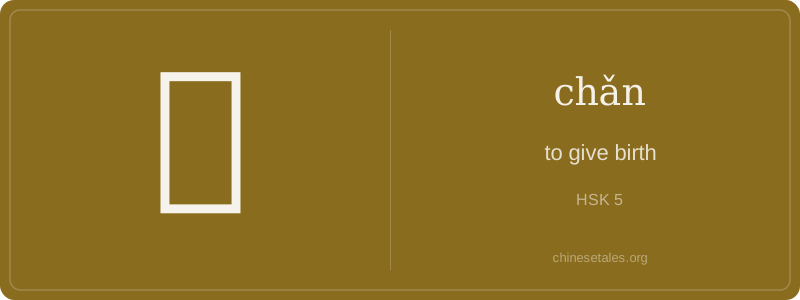
The earliest form of 产 appears in Warring States bamboo slips as a simplified evolution of 生 (shēng, ‘to be born’) — but with a critical twist: instead of 生’s full ‘sprouting plant’ glyph, 产 drops the lower ‘soil’ component (土) and replaces it with a stylized ‘platform’ or ‘birthing surface’, represented by the top radical 亠 (tóu, ‘lid/cover’) plus the vertical stroke and two short slants beneath. Visually, it’s a woman on a birthing stool — head covered (亠), body upright (丨), legs apart (the two diagonal strokes, 丿 and ㇏), all rendered in just six decisive strokes. Over centuries, the slants sharpened, the vertical straightened, and the ‘cover’ flattened into today’s clean, angular 产.
This wasn’t just shorthand — it was semantic intensification. While 生 evoked organic growth, 产 highlighted human intervention: the deliberate act of delivery. In the *Zuo Zhuan*, 产 appears in records of noble births — ‘Duke Zhuang was born from his mother’s right side’ — underscoring status and legitimacy. By the Han dynasty, it expanded beyond biology to mean ‘to yield’ (as in land producing grain), then ‘to manufacture’ (Tang texts mention silk 产 at state workshops). The character’s stark geometry mirrors its conceptual precision: no ambiguity — something *has been brought forth*.
At its heart, 产 (chǎn) is about emergence — the dramatic, life-altering moment something comes *into being*: a baby, a new idea, a factory’s output, or even a nation’s founding. It carries weight and consequence, never casualness. Unlike the neutral verb 生 (shēng, 'to be born'), 产 implies active production — often with effort, intention, or systemic involvement. Think of it as the 'labour' in 'laboratory': not just happening, but *being brought forth*.
Grammatically, 产 functions as both verb and noun (e.g., ‘production’), and frequently appears in compound verbs like 产生 (chǎnshēng, ‘to generate’) or passive constructions like 被产下 (bèi chǎn xià, ‘was delivered’). Learners often overuse it for everyday birth — saying 我产了一个孩子 sounds jarringly clinical (like ‘I produced a child’ in a factory manual); native speakers prefer 生了 or 分娩了. Reserve 产 for contexts where agency, scale, or formal documentation matters: medical reports, economic data, or historical narratives.
Culturally, 产 echoes China’s deep-rooted emphasis on continuity and contribution: one doesn’t just exist — one *produces* value, lineage, or legacy. Its use in terms like 国产 (guóchǎn, ‘domestically produced’) or 产后 (chǎnhòu, ‘postpartum’) reveals how intimately biology, industry, and identity are interwoven. A common slip? Confusing it with 由 (yóu, ‘by/from’) — visually dissimilar but phonetically distant; the real trap is tone: chǎn (third tone) ≠ chān (first tone, ‘to join’).