制
Character Story & Explanation
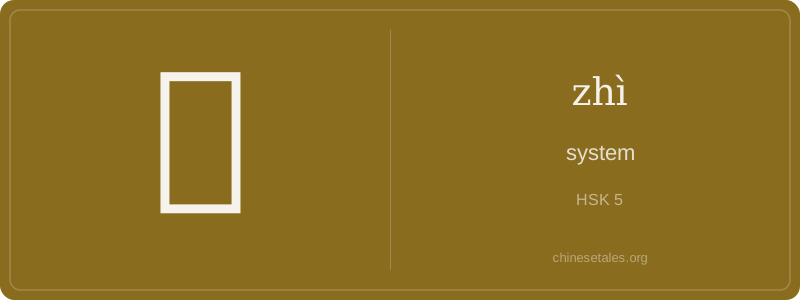
The earliest form of 制 appears in bronze inscriptions as a compound: on the left, a simplified hand (又 yòu) holding a tool; on the right, a knife (刂) — together picturing 'cutting cloth to size', the ancient craft of tailoring uniforms or ritual robes. Over centuries, the hand evolved into the top component 未 (wèi, originally depicting tree branches), while the knife remained firmly anchored at the right as 刂 — a visual echo of precision, control, and standardized measurement. The eight strokes crystallized by the Han dynasty, balancing symmetry and sharpness.
This sartorial origin explains everything: 制 didn’t mean 'system' at first — it meant 'to cut to measure', then 'to regulate by standard', then 'to institute'. By the Warring States period, philosophers like Xunzi used 制 in texts like *Xunzi* (《荀子》) to discuss 'ritual systems' (礼制 lǐzhì) — not mere customs, but codified, enforceable norms. Even today, the knife radical reminds us that every system requires a decisive, sometimes restrictive, act of definition — like cutting fabric, you can’t have order without a clean edge.
Think of 制 (zhì) as China’s ‘architectural blueprint’ character — not just 'system' in the abstract, but the deliberate, authoritative act of *designing and enforcing* structure. Unlike English 'system' (which can be organic or accidental), 制 always implies human agency: a ruler, institution, or committee *making* rules — like a constitutional convention drafting a framework, not a biologist observing an ecosystem. That’s why you’ll see it in 制度 (zhìdù, 'institutional system'), 制定 (zhìdìng, 'to formulate [a policy]'), and even 制服 (zhìfú, 'uniform' — literally 'that which controls/standardizes dress').
Grammatically, 制 is almost never used alone. It’s a bound morpheme — like the '-logy' in 'biology' — needing a partner to function. Learners often mistakenly say *'wǒ xūyào yīgè zhì'* ('I need a system'), but native speakers say *'wǒ xūyào yīgè zhìdù'* or *'yīgè guǎnlǐ zhìdù'*. Also watch tone: zhì (4th) is distinct from zhī (1st, e.g., 知) or zhí (2nd, e.g., 直) — mispronouncing it sounds like saying 'sheep' instead of 'ship'.
Culturally, 制 carries quiet authority — it’s the character behind China’s Five-Year Plans, national standards (国家标准 guójiā biāozhǔn), and even censorship systems (内容审核机制 nèiróng shěnhé jīzhì). A common learner trap? Confusing it with 治 (zhì, 'to govern/heal') — same sound, different radical, completely different logic: 治 fixes problems; 制 builds frameworks *before* problems arise.