似
Character Story & Explanation
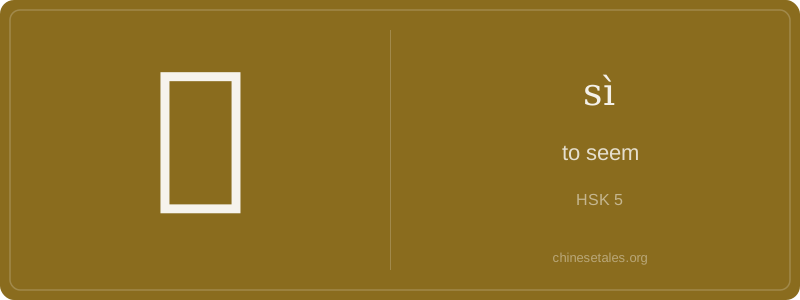
The earliest form of 似 appears in Warring States bamboo slips as 亻+㠯—a human radical paired with 㠯 (yǐ), an ancient variant of 以, which itself evolved from a pictograph of a hand holding a tool. In oracle bone script, 㠯 resembled a hand gripping a ceremonial scoop—symbolizing action, agency, or ‘using’ something to make a judgment. Over centuries, 㠯 simplified into the modern 'arrows-and-crossbar' shape (一丨) we see today, while 亻 remained steadfast—reminding us this is about *people* perceiving, comparing, and interpreting.
This visual origin explains why 似 means 'to seem': it’s not passive observation, but an active, human act of *applying judgment*—as if saying, 'I, a person, use my understanding to assess this likeness.' The Analects (17.22) uses it in the phrase '君子似玉' (jūnzǐ sì yù)—'The noble person seems like jade,' invoking moral resemblance through cultivated virtue. Even today, the stroke order (two quick strokes for 亻, then three deliberate ones for the right side) mirrors this idea: first the observer, then the thoughtful act of comparison.
At its heart, 似 isn’t about certainty—it’s about the gentle, almost poetic hesitation of perception: 'It seems like…', 'It appears as if…', 'It bears resemblance to…'. Unlike verbs like 是 (to be) or 像 (to look like), 似 carries a subtle literary weight and formal elegance—think classical poetry or legal documents, not casual WeChat chats. It’s a verb of comparison and impression, never assertion.
Grammatically, 似 most often appears in two patterns: (1) X 似 Y (X seems like Y), where it functions like a copula but with nuance—e.g., 他似有心事 (tā sì yǒu xīnshì) 'He seems preoccupied'; (2) in fixed compounds like 似乎 (sìhū) 'it seems that', which softens statements to express tentativeness or polite hedging—essential for sounding fluent and culturally appropriate. Learners often overuse 是 or mistakenly substitute 像, missing 似’s quiet authority and stylistic register.
Culturally, 似 reflects a deeply Chinese epistemological humility: reality is rarely black-and-white, so language leaves room for doubt. Confucian texts use it to temper judgments; modern writers deploy it to suggest ambiguity without vagueness. A common mistake? Using 似 alone as a standalone verb ('He seems' → *他似) — it almost always needs a complement (Y) or appears in compounds like 似乎 or 相似. Think of it as a bridge—not a destination.