布
Character Story & Explanation
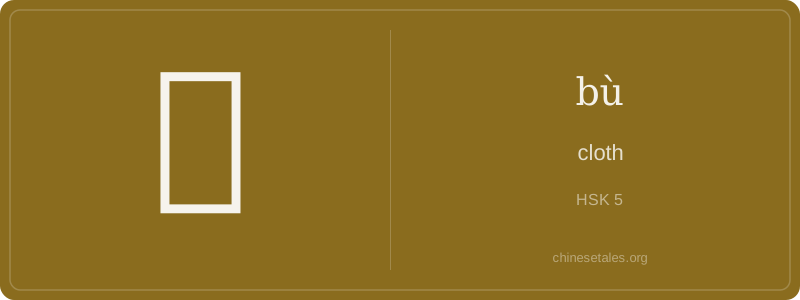
The earliest form of 布 appears in bronze inscriptions as a stylized pictograph: a square or rectangle (representing woven fabric) crossed by two parallel horizontal lines (symbolizing warp threads), all enclosed within the radical 巾 (jīn, ‘towel/cloth’). Over time, the top evolved into the simplified ‘丿’ and ‘一’, while the bottom condensed into ‘巾’ — preserving the cloth-in-a-frame concept. By the seal script era, the five-stroke structure was fixed: the first stroke (丿) suggests the drape of fabric, the second (一) the upper edge, the third (竖) the hanging fold, and the last two strokes (丨 and 丶) the tassels or weighted corners used to keep cloth taut during weaving.
This visual logic shaped its semantic journey: from literal woven textile in oracle bones (e.g., ‘献布于王’, ‘presented cloth to the king’ in Shang divinations), to metaphorical ‘spreading’ in classical texts — the Zuo Zhuan uses 布政 (bù zhèng, ‘spread governance’) to describe benevolent rule unfolding like fine cloth over land. Even today, the character’s shape whispers of intentionality: laying down cloth is an act of preparation, care, and quiet authority — no wonder it underpins words like 布局 (bùjú, ‘to set up a strategic layout’).
At its heart, 布 (bù) isn’t just ‘cloth’ — it’s the quiet, foundational texture of daily life in Chinese culture: the linen on a scholar’s desk, the silk in a bride’s gown, the coarse hemp of a farmer’s shirt. Unlike English, where ‘cloth’ is mostly a material noun, 布 in Chinese carries subtle grammatical flexibility — it can function as a noun (一块布, ‘a piece of cloth’), but also appears in verbs like 布置 (bùzhì, ‘to arrange/deploy’, literally ‘to lay out cloth’), echoing ancient rituals where spreading cloth marked sacred or official space. This metaphorical extension into ‘deployment’ (e.g., 布防 bùfáng, ‘to deploy defenses’) reveals how deeply material culture shapes abstract thought.
Grammatically, learners often overgeneralize 布 as a standalone word for ‘fabric’ — but in modern speech, it almost always appears in compounds (棉布, 丝绸布) or measure-word constructions (一匹布, yī pǐ bù). Saying *‘这个布很软’ sounds unnatural; native speakers say ‘这块布很软’ or better yet, ‘这料子很软’. Also, don’t confuse it with 衣服 (yīfu, ‘clothes’) — 布 is raw material, not finished garments.
Culturally, 布 evokes frugality and craftsmanship: the idiom 布衣 (bùyī, ‘cloth-garment’) historically meant ‘commoner’, contrasting with silk-wearing elites — a linguistic echo of Confucian social hierarchy. Today, 布 still carries warmth and authenticity (e.g., 手工布艺, ‘handmade textile art’), making it a gentle counterpoint to industrialized modernity.