余
Character Story & Explanation
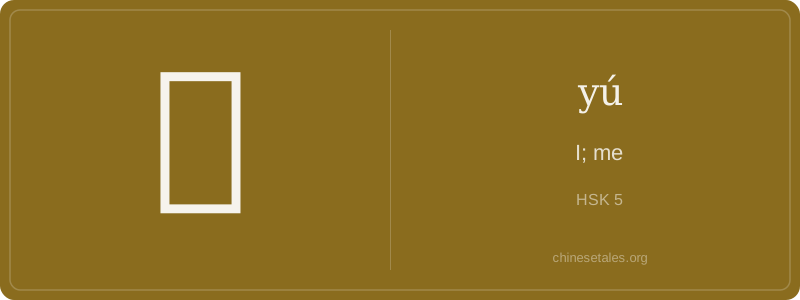
The earliest form of 余 appears on Shang dynasty oracle bones as a pictograph resembling a person (人) standing beside a simplified roof or shelter — possibly representing 'one who remains behind' or 'the one left in the dwelling'. Over centuries, the roof element evolved into the top horizontal stroke and the diagonal stroke beneath it, while the human radical 人 stabilized on the left. By the small seal script era (Qin dynasty), the character had condensed into its current seven-stroke shape: a clean, upright 人 on the left, and a compact, angular upper-right component that looks like a stylized 'hand holding something' — but scholars now agree it’s a phonetic-semantic fusion, preserving both sound (yú) and the idea of 'remaining' or 'surplus'.
This visual logic shaped its meaning: originally 'what remains after division' (hence 'surplus', 'remainder'), 余 gradually acquired the first-person pronoun sense through classical literary convention — likely because 'I' is the one 'remaining' as speaker, the sole constant in discourse. Confucius used it in the Analects (e.g., '余闻之久矣' — 'I have heard this for a long time'), cementing its role as the refined voice of authority and introspection. Even today, seeing 余 instantly evokes ink-brush elegance — not grammar drills.
At first glance, 余 (yú) feels like a humble little word — just 'I' or 'me' — but don’t be fooled: it’s the quiet aristocrat of Chinese pronouns. Unlike the neutral wǒ 我 (the default 'I'), 余 is literary, classical, and carries subtle weight: it’s the 'I' you’d use in a Tang dynasty poem, a formal essay, or a self-deprecating speech at a banquet. It’s never casual — you won’t hear it ordering dumplings at a street stall. Think of it as the Mandarin equivalent of saying 'methinks' instead of 'I think': same meaning, vastly different register.
Grammatically, 余 functions identically to other subject pronouns: it appears before verbs ('余未至' — 'I have not yet arrived'), can be followed by 的 for possession ('余之书' — 'my book'), and even takes object markers like 余之身 (literally 'my body', used reflexively). But crucially, it *never* appears in spoken Mandarin outside fixed idioms or highly stylized contexts — a classic HSK 5 trap! Learners often overuse it trying to sound 'more Chinese,' only to sound like a Ming-dynasty scholar accidentally time-traveled to a WeChat group.
Culturally, 余 reflects an ancient humility: in classical texts, it often implies 'this unworthy one' — a modest self-reference echoing Confucian ideals. That’s why it survives today in set phrases like 余勇可贾 (yú yǒng kě gǔ — 'still enough courage left to sell') or in surnames (Yú family). The biggest mistake? Using it where wǒ belongs — imagine signing a rental contract with '余同意' instead of '我同意'. Legally valid? Yes. Socially awkward? Profoundly.