傍
Character Story & Explanation
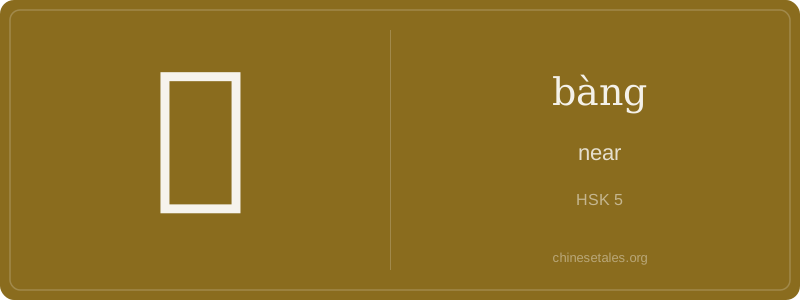
The earliest form of 傍 appears in seal script as a combination of 亻 (rén, 'person') and 傍’s right-hand component — originally a phonetic loan from 旁 (páng, 'side'), which itself evolved from a pictograph of two trees flanking a path. In bronze inscriptions, 旁 looked like two vertical strokes (trees or posts) framing a central line (a road), visually encoding 'flanking both sides'. When 亻 was added to create 傍, it emphasized *a person positioned alongside something* — not just near, but relationally anchored.
This visual logic held firm across clerical and regular script: the left radical 亻 stays constant, while the right side simplifies into 彷 (a variant of 旁) — preserving the 'person + flank' idea. By the Tang dynasty, 傍 appears in Du Fu’s poems describing poets ‘bàn shān’ (beside mountains) — not climbing them, but dwelling companionably *with* them. Its meaning never strayed far from this core: proximity as presence, not proximity as distance. Even today, 傍晚 doesn’t mean 'near evening' — it means 'the time when day leans into night', preserving that ancient, embodied sense of gentle transition.
At its heart, 傍 (bàng) isn’t just ‘near’ — it’s *intimate proximity*, the kind that implies adjacency with quiet intentionality. Unlike the neutral 靠 (kào, 'to lean on') or the spatially vague 附近 (fùjìn, 'vicinity'), 傍 carries a subtle sense of lingering, accompanying, or even clinging — think 'beside' with soft persistence, not mere physical closeness. You’ll rarely hear it alone; it almost always appears in compounds (like 傍晚) or as part of literary or formal phrasing.
Grammatically, it functions primarily as a verb ('to be beside') or as a prefix in time expressions, never as a standalone preposition like English 'near'. Learners often mistakenly try to say *bàng zhèr* ('near here') — but that’s ungrammatical; instead, you’d use 在旁边 (zài pángbiān) or 附近. 傍 only pairs naturally with nouns denoting time (傍晚), places (傍山), or abstract companionship (傍人). Its verbal use is poetic: 傍花随柳 (bàng huā suí liǔ, 'strolling beside flowers and following willows') evokes classical wanderings — not GPS coordinates.
Culturally, 傍 reflects a relational worldview: location is defined through connection, not isolation. It’s why 傍晚 feels warmer than 晚上 — it’s not just 'evening', but 'the time when light leans gently against the horizon'. A common trap? Confusing it with 旁 (páng), which means 'side' as a noun — but 傍 is the *act* of being at that side. Overuse sounds archaic or overly literary; underuse misses a layer of lyrical precision native speakers instinctively reach for in poetry, song lyrics, and refined speech.