傻
Character Story & Explanation
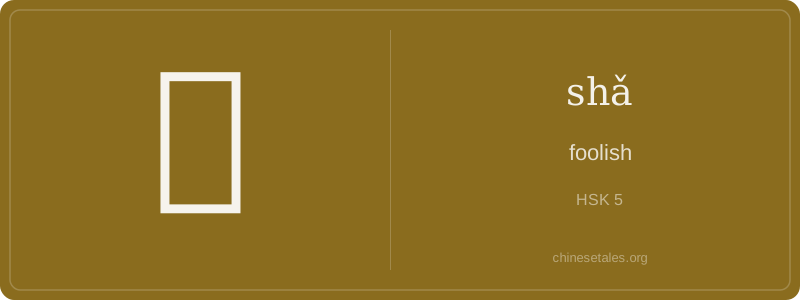
The earliest form of 傻 appears in seal script (c. 3rd century BCE), built from the radical 亻 (rén, ‘person’) on the left and the phonetic component 奢 (shē, ‘luxurious; extravagant’) on the right. While 奢 itself evolved from pictographs of a person holding ceremonial wine vessels, here it serves mainly as a sound hint. Over time, the right side simplified: the upper part became 尸 (shī, ‘corpse’-like shape, now a stylized roof-like stroke), and the lower part condensed into 亠 + 口 — giving us today’s 13-stroke structure. Visually, it’s a person standing beside a strangely ornate, almost top-heavy silhouette — like someone trying too hard to look smart and accidentally looking ridiculous.
This visual irony mirrors its semantic journey: in early texts like the *Shuōwén Jiězì* (121 CE), 傻 was defined as ‘lacking discernment’ (不慧), but by the Ming and Qing dynasties, vernacular novels like *The Plum in the Golden Vase* used it affectionately — describing characters whose naivety revealed moral purity or unguarded emotion. The ‘extravagant’ root 奢 subtly reinforces this: foolishness here isn’t dullness, but *excess* — too much trust, too much hope, too much heart poured into the wrong place.
At its core, 傻 (shǎ) isn’t just ‘foolish’ — it’s warm, human foolishness: the kind that makes you forget your keys *again*, laugh too loudly at your own joke, or fall for a scam because you trusted someone’s smile. It carries affectionate exasperation, not cold judgment — think ‘sweetly clueless’ more than ‘intellectually deficient’. Unlike 愚 (yú, formal/philosophical ‘stupid’) or 笨 (bèn, ‘clumsy’ or ‘slow-witted’), 傻 implies a lack of worldly savvy, not low intelligence.
Grammatically, 傻 is most often an adjective (e.g., 他真傻 — Tā zhēn shǎ — ‘He’s so silly!’), but it also appears in common fixed expressions like 傻瓜 (shǎguā, ‘silly goose’, used playfully between friends or lovers) and as a verb in colloquial speech: 傻笑 (shǎ xiào, ‘to grin foolishly’). Crucially, it’s rarely used in formal writing or serious critique — calling a colleague 傻 in a meeting would be deeply inappropriate. Learners often overuse it literally, missing its emotional texture: it’s rarely insulting unless tone and context turn it sharp.
Culturally, 傻 has surprising warmth — parents call children 傻孩子 (shǎ háizi, ‘silly child’) with tenderness; lovers whisper 傻瓜 (shǎguā) as a term of endearment. The character even appears in classical idioms like 傻里傻气 (shǎ lǐ shǎ qì, ‘goofily earnest’), highlighting how ‘foolishness’ can signal sincerity. A common mistake? Using 傻 to translate English ‘stupid’ in academic or professional contexts — where 笨, 愚, or even 白痴 (báichī, vulgar) might fit better, depending on register and intent.