偿
Character Story & Explanation
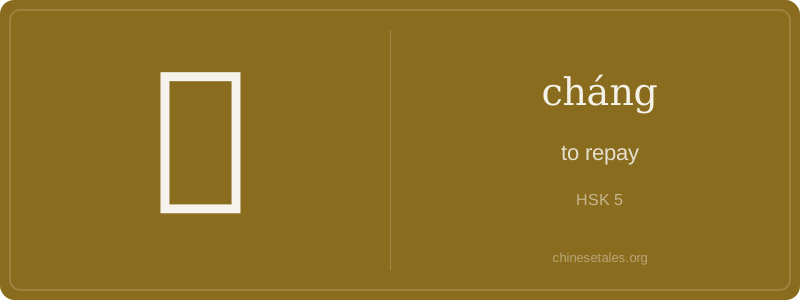
Carve this image in your mind: early bronze inscriptions show a person (亻) standing beside a stylized 'shell' (貝) — ancient China’s first currency — and beneath them, a hand holding a measuring tool (⺅, a variant of 刂, 'knife/cut'). The original idea was precise, ritualistic settlement: a human agent using calibrated action to restore fairness after exchange or injury. Over centuries, the 'shell' simplified into the top-right 赏 component (yes — the same as in 'reward'!), while the knife-hand became the lower 刂 — making 偿 a visual contract: 'a person + measured action = restoration of balance'.
This balance concept deepened in classical texts: in the *Zuo Zhuan*, officials are praised for '以德报怨,不偿其恶' ('responding to ill will with virtue, not repaying evil with evil') — showing 偿 already carried ethical weight, not just commerce. By the Tang dynasty, poets used 偿 in melancholic lines like '此恨不偿终是憾' ('This regret remains unrepaid — forever a sorrow'), proving its emotional resonance. The modern form keeps that ancient promise: every stroke enacts a deliberate, responsible settling of accounts — whether gold, guilt, or grief.
Think of 偿 (cháng) not as dry 'repayment' but as a moral balancing act — it’s the character Chinese uses when debts, apologies, or even karmic obligations must be settled. It carries weight: you don’t just 'pay back' money with 偿; you *atone*, *compensate*, or *make amends*. That gravity means it rarely appears alone — almost always in compounds like 赔偿 (péicháng, 'to compensate') or 偿还 (chánghuán, 'to repay a loan'). You’ll almost never say *'I 偿 you'*. Instead, it’s 'I will 偿还 the debt' or 'The company must 赔偿 the loss'.
Grammatically, 偿 is strictly transitive and formal — no casual speech, no slangy shortcuts. Learners often misplace it by trying to use it like English 'repay' with a direct object: ❌ '我偿你钱' (I repay you money). Correct? ✅ '我偿还这笔钱' (I repay this sum of money) — where the object is the *debt*, not the *person*. Also watch tone: cháng (2nd), not chǎng or chāng — mispronouncing it risks sounding like 'chang' (a surname) or worse, confusing it with 尝 (cháng, 'to taste').
Culturally, 偿 ties into Confucian ideas of reciprocity and responsibility: if you receive kindness or cause harm, balance must be restored — not just legally, but ethically. That’s why it appears in phrases like 报偿 (bàocháng, 'reward/retaliation') — where 'reward' and 'retribution' share the same root. A common mistake? Using it for everyday 'paying' (use 付 fù instead). 偿 is for solemn reckonings — financial, emotional, or cosmic.