充
Character Story & Explanation
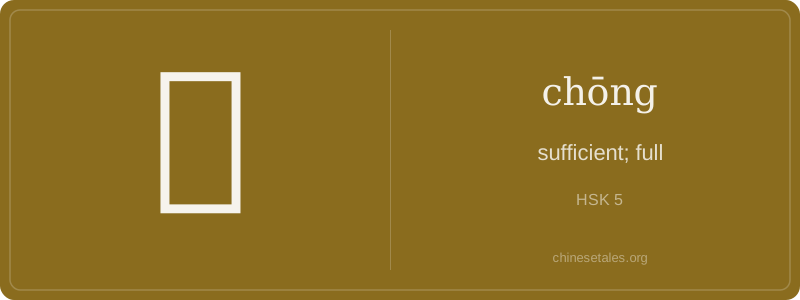
The earliest form of 充 appears in bronze inscriptions as a pictograph combining two elements: a person (人) kneeling or bowing, and a hand (又) pressing down on their back — suggesting ‘to press someone into service’ or ‘to assign a role’. Over centuries, the person simplified into 儿 (a stylized crouching figure, not ‘child’ here!), and the hand evolved into the top component 冖 (a covering) + 一 (horizontal stroke), eventually merging into today’s upper part. By the seal script era, the shape stabilized: 冖 (cover) + 一 (line) + 儿 (crouching person) — visually ‘covering a person to assign duty’.
This origin explains why 充’s core sense is ‘to fill a role’ — not physical filling. In the Book of Rites, 充 is used in 充位 — ‘to occupy a position formally, without true authority’, revealing its early bureaucratic nuance. Later, through semantic extension, ‘filling a role’ broadened to ‘being sufficient to meet a requirement’ — hence 充分 (sufficient) and 充足 (adequate). The radical 儿, though misleadingly read as ‘child’, preserves the ancient image of a subordinate figure — making 充 one of Chinese’s most quietly hierarchical characters.
Imagine you’re at a Beijing teahouse, watching an elderly master pour tea into tiny cups — not to the brim, but just right: enough to warm the cup, fill the aroma, and leave room for grace. That ‘just right’ fullness? That’s 充 (chōng). It doesn’t mean ‘overflowing’ like 满 (mǎn), nor ‘stuffed’ like 塞 (sāi); it’s the satisfying sufficiency of completeness — whether it’s time, energy, proof, or authority. In Chinese, 充 often functions as a verb meaning ‘to serve as’, ‘to act as’, or ‘to fill (a role)’: 充当老师 (chōng dāng lǎo shī) — ‘to act as a teacher’.
Grammatically, 充 is rarely used alone; it loves partners. With 当 (dāng), it becomes 充当 — ‘to assume/serve in a role’. With 分 (fēn), 充分 means ‘sufficient’ or ‘adequate’ — a key HSK 5 adjective (e.g., 充分的理由). Crucially, 充 never stands for physical fullness like a cup of water — that’s 满. Learners often overuse 充 for ‘full’ and sound unnatural. Also, watch tone: chōng (1st tone), not chòng (4th), which means ‘to rush headlong’ — a totally different word!
Culturally, 充 carries quiet weight: in classical texts like the Mencius, 充 is paired with ‘virtue’ (德) — 充德 — meaning ‘to fully embody moral integrity’. Today, it appears in bureaucratic phrases like 充分发挥 (chōng fēn fā huī, ‘to fully bring into play’) — hinting at China’s emphasis on measured, purposeful capacity, not mere abundance. Its power lies in intentionality: it’s not about having *more*, but being *enough* — precisely what’s needed, nothing less, nothing excess.