兵
Character Story & Explanation
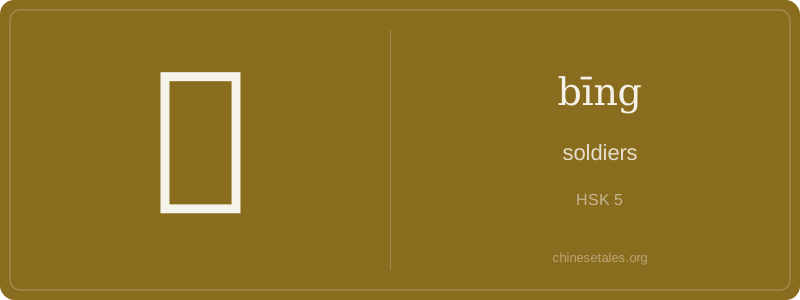
The earliest form of 兵 appears in bronze inscriptions (c. 11th–3rd century BCE) as a combination of ⼒ (lì, 'strength') and 廾 (gǒng, 'two hands holding up') — but crucially, it included a distinct weapon element: a stylized axe or halberd (斤, jīn) at the top. Over time, the weapon simplified into the two dots and slant (丷), while the lower part evolved from 廾 into the current 八 radical — not because it means ‘eight’, but because the shape of two diverging strokes mirrored the stance of warriors bracing for combat. The seven strokes we write today preserve this kinetic tension: the top dots (like helmet plumes), the central vertical (a spear shaft), and the spreading 八 (legs planted wide, ready to charge).
This visual logic shaped its meaning: 兵 wasn’t ‘man + weapon’, but ‘armed person in formation’. In the *Zuo Zhuan*, it distinguishes conscripted peasants-turned-fighters (兵) from professional officers (将, jiàng) — highlighting class and role. By the Han dynasty, 兵 became synonymous with state-controlled military power, appearing in texts like *The Book of Han*: ‘募天下兵’ (mù tiānxià bīng, ‘recruit troops nationwide’). Even today, its form whispers readiness — not aggression, but disciplined potential.
Think of 兵 (bīng) as the Chinese equivalent of the word 'troops' in English military jargon — not just individual soldiers, but organized, armed force with purpose and hierarchy. Unlike English 'soldier', which centers on a person, 兵 carries an institutional weight: it’s the 'unit' in 'fire unit', the 'force' in 'peacekeeping force'. You’ll rarely hear it used alone to mean 'a soldier' in modern speech — that’s more commonly 士兵 (shìbīng) or 军人 (jūnrén); 兵 is reserved for collective, functional, or historical contexts: 兵力 (bīnglì, 'military strength'), 兵器 (bīngqì, 'weapon'), or in classical idioms like 纸上谈兵 (zhǐ shàng tán bīng, 'armchair general').
Grammatically, 兵 is almost never a standalone subject in casual speech — you won’t say *‘兵来了’* to mean ‘a soldier arrived’ (that sounds archaic or poetic). Instead, it appears in compound nouns, measure words (e.g., 一兵, yī bīng — extremely formal/literary), or as part of fixed expressions. Crucially, it’s *not* a verb — learners sometimes misread 兵 as related to ‘to fight’ (like 战 zhàn), but it’s purely nominal. And no, it doesn’t mean ‘weapon’ by itself — that’s 兵器; confusing the two is like saying ‘troop’ instead of ‘rifle’.
Culturally, 兵 evokes the Warring States era and Sun Tzu’s Art of War — where ‘the art of using 兵’ meant strategic deployment, not brute force. Modern usage retains that nuance: calling something a ‘兵家必争之地’ (bīngjiā bì zhēng zhī dì) — ‘a place every strategist must seize’ — signals high-stakes competition, whether in business or tech. A common mistake? Overusing 兵 as a generic synonym for ‘person in uniform’. Remember: it’s about function, formation, and force — not identity.