兼
Character Story & Explanation
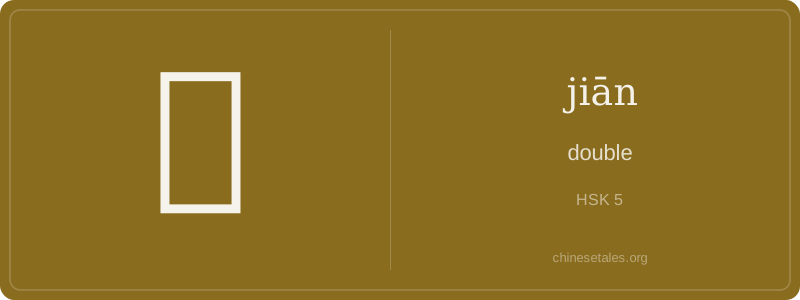
The earliest form of 兼 appears in bronze inscriptions as two hands () gripping a bundle of grain stalks — not one, but *two* sheaves held tightly together. That original pictograph had symmetrical arms embracing a central vertical line (representing stalks), making the idea of ‘holding both’ viscerally clear. Over centuries, the arms simplified into the radical 丷 (like two inverted ‘v’s) at the top, while the stalks evolved into the lower part: 一 (horizontal stroke), then 灬 (four dots — a stylized ‘fire’ variant that here actually derives from bundled stalks, not fire!), and finally the modern 、丿丨 combined into the bottom ‘兼’ shape we see today — still echoing duality and grasp.
This visual logic directly shaped its meaning: ‘to hold two things simultaneously’. By the Warring States period, it appeared in texts like the Mohist Canons advocating 兼愛 — universal love that includes *everyone*, not just kin. Later, in the Book of Rites, it described ritual officials who 兼掌 multiple duties. Even today, the character’s upper 丷 looks like two shoulders bearing weight — a perfect visual metaphor for its enduring sense of balanced responsibility, not mere doubling.
At its heart, 兼 isn’t just ‘double’ — it’s the elegant tension of holding two things *at once* without dropping either: dual roles, overlapping responsibilities, simultaneous truths. Think ‘兼職’ (part-time job while studying) or ‘兼容’ (a phone that works with both Android and iOS accessories). It carries a quiet sense of balance and capability — never conflict, always coexistence. Unlike English ‘double’, which can imply duplication or even deceit (‘double agent’), 兼 is inherently harmonious and respectful of complexity.
Grammatically, 兼 functions mainly as a verb (‘to combine, to hold concurrently’) or in compound nouns/adjectives. It rarely stands alone — you’ll almost never say ‘我兼’ — but shines in structures like 兼…又… (‘not only… but also…’) or as the first character in verbs like 兼顧 (to take into account both sides). Learners often mistakenly use it where 當 or 擔任 would be more natural for ‘to serve as’ — remember: 兼 implies *added* duty, not primary identity. Also, don’t confuse it with simple repetition: 兼 is about integration, not duplication.
Culturally, 兼 reflects a core Confucian value: the ideal person doesn’t choose between roles (son *or* official), but fulfills them *simultaneously* with integrity. This nuance appears in classical texts like the Mencius, where rulers are urged to 兼愛 (‘care for all impartially’) — a radical idea contrasting with hierarchical love. A common learner trap? Using 兼 when they mean ‘also’ (also = 也 or 又); 兼 is weightier, more formal, and always implies active, conscious juggling — not just addition.