册
Character Story & Explanation
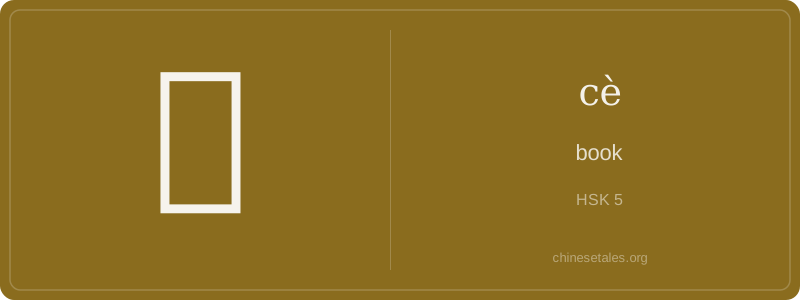
The earliest form of 册 appears in oracle bone inscriptions as a vivid pictograph: two parallel vertical lines (representing bamboo or wooden slips), crossed by three or four horizontal lines (the binding cords holding them together). Imagine thin, rigid slats tied neatly at top, middle, and bottom — exactly how ancient scribes stored texts. Over centuries, the form simplified: the outer frame solidified into the radical 冂 (jiōng, 'arch'), while the inner strokes condensed into two short horizontals and a central vertical — the modern five-stroke shape. Even today, those three internal lines whisper of ancient lashing techniques.
This wasn’t just 'a book' — it was *the* book: the medium of law, history, and ritual. Confucius is said to have edited the Book of Documents (《尚书》), originally recorded on such bamboo strips. The character’s structure literally enshrines the idea that knowledge must be *bound* — organized, preserved, and made durable. Later, when paper replaced bamboo, the character kept its meaning but gained new life in bureaucratic language: 一册户口簿 (yī cè hùkǒu bù) — 'one volume of the household registration book' — showing how deeply its material origin shaped China’s administrative imagination.
At first glance, 册 (cè) means 'book' — but not just any book. It evokes ancient bamboo strips bound together with leather thongs, the original Chinese 'book' long before paper existed. In modern usage, it carries a formal, official, or archival weight: you'd say 一册书 (yī cè shū) for 'a volume of a book' — think academic monographs or government reports — not your dog-eared novel. Unlike 书 (shū), which is the general, warm, everyday word for 'book', 册 feels precise, measured, and slightly bureaucratic.
Grammatically, 册 functions almost exclusively as a measure word — but only for bound, substantial publications. You wouldn’t use it for magazines (that’s 本 běn) or e-books (no standard measure). It also appears in compound nouns like 手册 (shǒucè, 'handbook') or 画册 (huàcè, 'art album'), where it signals a curated, physical collection. Learners often overgeneralize it ('I read three cè yesterday!'), but native speakers only use it when the object *feels* like a discrete, authoritative volume — a subtle but crucial cultural cue about value, permanence, and intellectual weight.
Interestingly, 册 rarely stands alone as a noun in speech ('This is a 册' sounds unnatural); it lives in compounds or with numbers/measure words. That reflects a deeper linguistic pattern: Chinese often avoids bare nouns in favor of context-rich phrases. Also, note that 册 is never used for digital content — no matter how 'book-like' an app feels. The character stubbornly preserves its tactile, pre-digital soul.