创
Character Story & Explanation
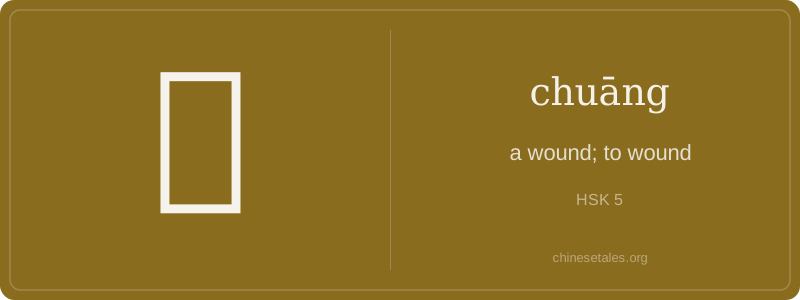
The earliest form of 创 appears in bronze inscriptions as a combination of two elements: a pictograph resembling a hand holding a blade (later simplified to 刂, the knife radical), and a component that looked like a person with a broken line across the torso — symbolizing a body breached by a weapon. Over centuries, the ‘person’ element evolved into the left-side component (仓), which originally depicted a granary but was borrowed here purely for sound (cāng → chuāng). By the Han dynasty, the character stabilized into its modern six-stroke form: 仓 + 刂 — literally ‘granary + knife’, though the granary has nothing to do with wounds; it’s just a phonetic anchor.
This semantic-phonetic split is classic Chinese character evolution: meaning lives in the radical (刂 = cutting action), sound lives in the left side (仓 = approximates chuāng). In classical texts like the Han Feizi, 创 appears in legal descriptions of bodily harm — ‘three 创s warrant exile’. Interestingly, its pronunciation chuàng (as in 创造, ‘to create’) emerged later via semantic extension: the idea of ‘cutting new ground’ → ‘making something new’. But for HSK 5, focus only on chuāng — the original, painful meaning remains etymologically primary and visually unforgettable.
At its heart, 创 (chuāng) is visceral — it’s the sharp *sting* of a cut, the sudden breach in skin or trust. Unlike abstract nouns like ‘injury’ (伤害), 创 carries the raw physicality of a wound: fresh, open, often bleeding. Think of it as the noun form of ‘to slash’ — not the act, but the gash itself. It appears most often in formal, literary, or medical contexts: ‘a deep 创’, ‘infected 创’, or ‘surgical 创’. You won’t hear it in casual speech like ‘I got a cut’ — for that, people say 割伤 or 破了皮. But in writing? It’s precise and weighty.
Grammatically, 创 is almost always a noun (never a verb at this reading!) and typically appears with measure words like 个, 处, or 条 — e.g., 一处创 (yī chù chuāng, 'a wound'). Crucially, it’s *not* used for emotional wounds — that’s 伤 (shāng) or 创伤 (chuāngshāng, where 创 is still pronounced chuāng but functions as part of a compound). Learners often misread it as chuàng here and force ‘create’ logic onto it — big red flag! Remember: chuāng = wound, period.
Culturally, 创 evokes classical restraint — it’s the word you’d find in Tang dynasty medical texts or Ming legal codes describing assault injuries. Its austerity makes it feel ‘official’, even solemn. A common mistake? Confusing it with 刃 (rèn, ‘blade’) or 易 (yì, ‘easy’) due to visual similarity — but those lack the knife radical on the right. Also, never use 创 alone to mean ‘injure’; that’s the verb 刺 (cì) or 伤 (shāng). Let 创 rest — quietly, painfully — as the noun it is.