劣
Character Story & Explanation
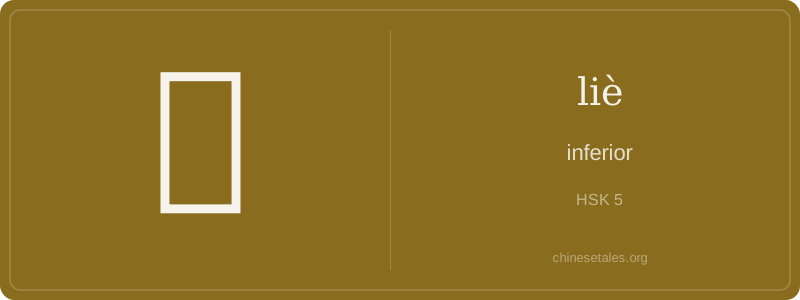
The earliest form of 劣 appears in bronze inscriptions as two stacked components: the top resembling 犬 (quǎn, ‘dog’) or a simplified head-and-body shape, and the bottom clearly 力 (lì, ‘strength’ or ‘effort’). Over centuries, the top eroded into the current 少 (shǎo, ‘few’ or ‘little’) — not by semantic choice, but through stylized simplification. So visually, modern 劣 looks like ‘little strength’ — a brilliant stroke-based metaphor that emerged organically from calligraphic evolution, not deliberate design.
This ‘little strength’ visual became inseparable from its meaning: lack of capability, deficiency, or inherent inadequacy. By the Han dynasty, 劣 was already used in texts like the Shuōwén Jiězì to describe subpar talent or flawed character — not just physical weakness, but moral or functional insufficiency. The character never meant ‘evil’ or ‘harmful’; its core has always been *deficit*: too little skill, too little integrity, too little substance. That’s why it pairs so naturally with nouns like 质 (quality) or 势 (advantage) — it names the gap where strength should be.
At its heart, 劣 (liè) isn’t just a dry label for ‘inferior’ — it carries a quiet moral weight. In Chinese, calling something 劣 isn’t neutral like ‘lower quality’ in English; it often implies a failure of effort, character, or fundamental suitability — think ‘shoddy’, ‘substandard’, or even ‘morally deficient’. You’ll rarely see it used alone as a noun; instead, it’s almost always part of compounds (like 劣势 or 劣质) or paired with verbs like 显示 (to reveal) or 属于 (to belong to).
Grammatically, 劣 is strictly an adjective — and crucially, it’s *not* used predicatively without a verb or structure. You can’t say *‘这个产品很劣’ — that’s unnatural and ungrammatical. Instead, you’d say ‘这个产品质量劣’ (the product’s quality is poor) or better yet, ‘质量低劣’ (low and inferior — a fixed collocation). Learners often overextend it like English ‘bad’, but 劣 feels sharper, more judgmental, and almost bureaucratic in tone.
Culturally, 劣 appears frequently in official discourse: government reports on ‘劣质食品’ (substandard food), media critiques of ‘劣迹艺人’ (celebrities with misconduct records), or economic analyses of ‘劣势产业’ (industries at a structural disadvantage). A common mistake? Confusing it with 恶 (è, ‘evil’) — while both carry negative force, 劣 is about *inadequacy*, not malice. Also, avoid using it in casual speech; it sounds overly formal or accusatory outside serious contexts.