匀
Character Story & Explanation
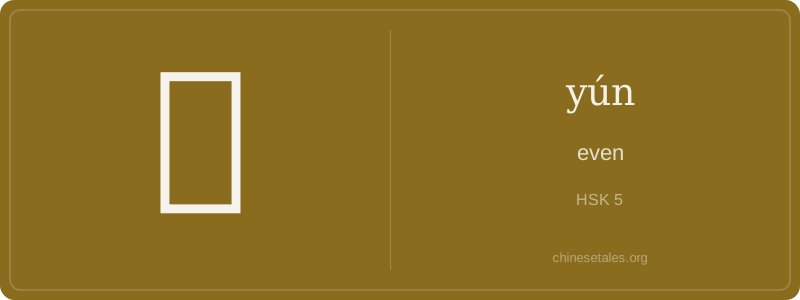
The earliest form of 匀 appears in Warring States bamboo texts as a simple yet clever glyph: a curved enclosure (the ancestor of 勹) cradling a single horizontal stroke — like a gentle scoop holding one equal unit. That curve wasn’t just decorative; it evoked the motion of scooping and redistributing — think of a ladle drawing broth from a pot and pouring it evenly into bowls. Over centuries, the interior stroke stabilized into a clean horizontal line, while the enclosing curve hardened into the modern 勹 radical, losing its pictorial ‘ladle’ shape but keeping its sense of *containment + action*.
This visual logic directly shaped its meaning evolution. In the Book of Rites, 匀 appears in contexts like ‘匀其劳’ (‘distribute labor evenly’), linking fairness to ritual harmony. By the Tang dynasty, poets used it metaphorically — Li Bai wrote of clouds ‘匀散天光’ (‘evenly scattering celestial light’), transforming a practical scooping gesture into an image of cosmic balance. Even today, the character’s four strokes whisper its essence: minimal, deliberate, and profoundly relational — never about perfection, but about mindful sharing.
Think of 匀 (yún) as the Chinese equivalent of a perfectly calibrated kitchen scale — not flashy, but absolutely essential for balance. Its core meaning 'even' isn’t just about visual symmetry; it’s about *intentional distribution*: spreading effort, time, resources, or attention so nothing is overburdened or neglected. Unlike English ‘even’, which often describes static states (‘even surface’), 匀 is almost always *verbal* and *active* — you *do* 匀, like stirring batter until smooth or allocating tasks fairly among teammates.
Grammatically, it’s a transitive verb (often with 把 or 被) and rarely stands alone: you don’t say ‘it’s 匀’ — you say ‘把时间匀出来’ (‘carve out time’) or ‘水分分布不匀’ (‘moisture distribution is uneven’). Learners frequently misplace it as an adjective (e.g., ❌‘这个很匀’) — but it’s never predicative like 均匀 (jūnyún), its more formal sibling. Also beware: 匀 is almost exclusively used in *abstract* distribution — never for physical objects you ‘even out’ like fabric or paint (that’s 拉平 or 摊平).
Culturally, 匀 carries quiet ethical weight: in Confucian-influenced teamwork, ‘匀出精力帮同事’ (‘divert energy to help a colleague’) signals humility and collective responsibility. A common slip is overusing 均匀 when 匀 would sound more natural and human — e.g., in spoken Mandarin, ‘把工作量匀一下’ feels warmer and more collaborative than ‘使工作量均匀化’ (which sounds like a factory manual).