勿
Character Story & Explanation
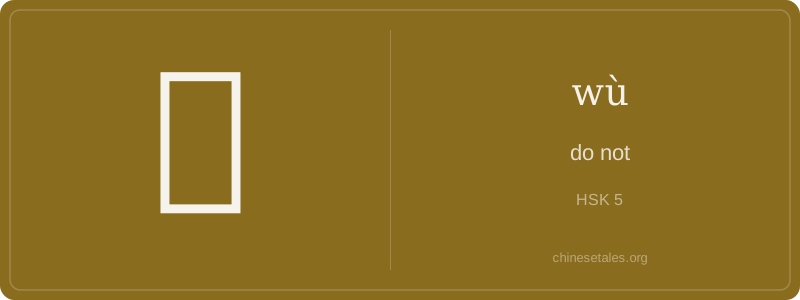
The earliest form of 勿 appears in Shang dynasty oracle bone inscriptions as a stylized pictograph: a curved enclosure (later becoming 勹) containing three short diagonal strokes — originally representing flying feathers or scattered dust, symbolizing 'dispersion' or 'scattering away'. Over time, those three strokes simplified into the three short lines we see today inside the 'enveloping' radical 勹, while the enclosing curve hardened into its modern hook shape. Crucially, this wasn’t a picture of a person or object — it was an abstract glyph of *removal*: what is enclosed is being actively dispersed, banished, or negated.
This visual logic — enclosure + dispersal = prohibition — became semantic bedrock. By the Warring States period, 勿 was firmly established as a negative imperative particle in texts like the *Analects* (e.g., '君子勿欺' — 'The gentleman must not deceive'). Its form never lost its 'contain-and-repel' essence: the 勹 radical cradles the negation, as if holding back action itself. Even today, when you write those four strokes — one curved embrace followed by three decisive dashes — you’re tracing a 3,000-year-old gesture of restraint.
At its core, 勿 (wù) is the crisp, authoritative 'do not' — not a gentle suggestion like 别 (bié), but a formal, often written or classical prohibition. Think of it as the red stop sign of Chinese grammar: absolute, unyielding, and slightly stern. It carries the weight of ancient edicts and moral injunctions — you’ll find it in Confucian texts, official notices, and modern warning signs ('勿靠近' — 'Do not approach'). Unlike 别, which flows naturally in speech ('别走!' — 'Don’t go!'), 勿 feels deliberate, almost ceremonial.
Grammatically, 勿 always precedes a verb and never stands alone. It’s strictly monosyllabic and cannot be modified — no aspect particles like 了 or 过 attach directly to it. Learners often mistakenly insert it mid-sentence or pair it with 了 ('勿吃了'), but that’s ungrammatical; instead, use 勿 + bare verb ('勿吃'). Also, it rarely appears in casual spoken Mandarin — hearing 'wù chī' in daily conversation would sound oddly literary or even theatrical!
Culturally, 勿 echoes the Confucian ideal of self-restraint and mindful action. Its presence signals seriousness: on a lab door ('勿触摸'), it conveys scientific caution; in a poem ('勿忘初心'), it evokes solemn remembrance. A common mistake is overusing it in writing thinking it sounds 'more correct' — but native speakers reach for 别 or 不要 unless tone demands gravity or concision. Remember: 勿 isn’t stronger than 不要 — it’s *different*, like choosing between a gavel and a raised finger.