嗓
Character Story & Explanation
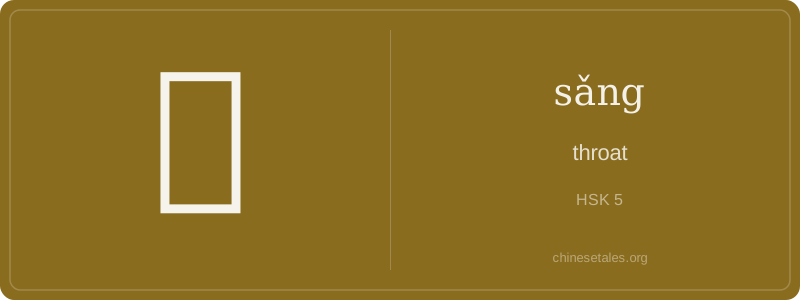
The earliest form of 嗓 isn’t found in oracle bones — it’s a relatively late creation, emerging during the Ming-Qing transition as vernacular literature exploded. Its structure is brilliantly transparent: left side 口 (kǒu, ‘mouth’) anchors it in speech and sound; right side 桑 (sāng, ‘mulberry tree’) provides both phonetic clue (sǎng shares the ‘-ang’ rhyme with sāng) and subtle symbolism — mulberry leaves feed silkworms, and silk threads were historically used in early stringed instruments, linking sound production to organic origin. Over centuries, the 桑 component simplified from its full 10-stroke form to today’s streamlined version, losing two horizontal strokes but keeping the distinctive ‘three twigs + wood’ skeleton.
Originally appearing in late imperial fiction like The Plum in the Golden Vase, 嗓 described not just physical anatomy but vocal capacity — ‘a clear 嗓’ meant a voice fit for singing or public speaking. By the Qing dynasty, it had become inseparable from performance culture: actors trained their 嗓zi rigorously, and critics wrote of ‘a 嗓 that could pierce bamboo’. The character’s visual duality — mouth + mulberry — quietly encodes an ancient truth: voice isn’t just air and tissue; it’s cultivated, fed, and shaped, like silk from leaf.
Imagine a Beijing opera singer mid-performance — eyes blazing, sleeves swirling — suddenly clutching their throat as a raspy croak escapes instead of the soaring high note. That raw, vulnerable moment? That’s 嗓 (sǎng) in action: not just ‘throat’ as anatomy, but the living, breathing *instrument* of voice itself. In Chinese, 嗓 carries visceral weight — it’s where emotion cracks through, where fatigue or illness hits first, and where vocal identity lives. You’d never say ‘my 嗓 is sore’ like ‘my arm is sore’; it’s always 嗓子 (sǎngzi), the colloquial, affectionate diminutive form — even in formal writing, 嗓 appears almost exclusively in compound words or set phrases.
Grammatically, 嗓 rarely stands alone. It’s a noun that demands context: you don’t ‘have a 嗓’, you have a *good* or *hoarse* 嗓子; you *clear* your 嗓zi or *strain* your 嗓zi. Learners often mistakenly use 嗓 as a bare noun like English ‘throat’ — e.g., ‘I hurt my 嗓’ — but native speakers would instantly correct it to ‘我伤了嗓子’ (wǒ shāng le sǎngzi). Notice the required -zi suffix and the verb ‘shāng’ (to injure), not ‘hurt’.
Culturally, 嗓zi is deeply tied to authenticity and presence — think of the gravelly 嗓zi of a veteran storyteller in a teahouse, or the ‘golden 嗓zi’ (jīn sǎngzi) awarded to radio hosts with effortlessly warm tones. A common mistake? Confusing it with 喉 (hóu), which is clinical, literary, and rarely used alone (e.g., 喉咙 lóng is the full term for ‘throat’). 嗓 feels intimate, human, slightly rough around the edges — like voice itself.