嗯
Character Story & Explanation
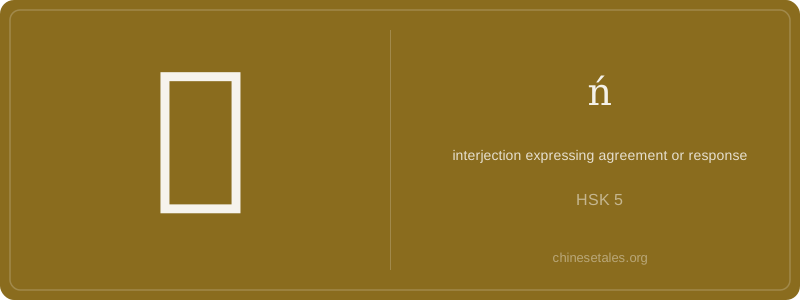
The earliest form of 嗯 appears not in oracle bones, but in late Ming and Qing vernacular manuscripts — because it wasn’t needed earlier. Classical Chinese avoided phonetic interjections entirely. Its character was deliberately constructed around 口 (kǒu, ‘mouth’) — the radical anchoring all vocal sounds — combined with ān (安, ‘peace/quiet’) as a phonetic component. Look closely: the right side is 安 without the roof (宀), simplified to 女 + 一 + 丿 — a stylized, cursive rendering that over centuries hardened into today’s 13-stroke form. No pictograph here — this is a *phonosemantic compound*, born from the need to transcribe real-time speech in fiction and drama.
Its semantic rise mirrors China’s literary shift: from the terse elegance of Tang poetry to the rich, voice-driven dialogue of 17th-century novels like The Plum in the Golden Vase, where 嗯 appears in marginalia and stage directions as actors’ cues. By the 20th century, Lu Xun used 嗯 repeatedly in Diary of a Madman to signal the protagonist’s fragmented consciousness — not as filler, but as psychological punctuation. Visually, the mouth radical cradles the quietness of 安, embodying the paradox of speaking through silence: a voiced pause that holds space, not meaning.
Forget dictionaries for a moment — 嗯 isn’t *about* meaning; it’s about presence. It’s the hum in your throat when you’re listening, the pause that says ‘I’m here, I hear you’ before your brain catches up. Unlike most HSK 5 characters, 嗯 carries zero lexical weight — no noun, verb, or adjective attached — yet it’s indispensable in spoken Chinese. It’s a vocal gesture, not a word: soft, nasal, and deeply contextual. You’ll hear it as a rising ń (like ‘hmm?’) for questioning, a flat en (‘uh-huh’) for agreement, or a falling èn (‘mmh’) for reluctant acknowledgment — all spelled the same way in writing.
Grammatically, 嗯 functions as a standalone interjection — never modified, never compounded with particles like 吧 or 啊. Learners often wrongly add tone marks to written 嗯 (e.g., ‘ń’ in pinyin), but in standard orthography, it’s always just 嗯 — the tone is inferred from context and speech. A classic mistake? Writing 嗯 as an answer to a question *without* matching the speaker’s tone — replying with flat en to a rising ń can sound dismissive or sarcastic. In texts, it’s often doubled (嗯嗯) for warmth, tripled (嗯嗯嗯) for playful impatience.
Culturally, 嗯 reveals how much Chinese relies on vocal prosody over syntax. In formal writing or classical texts, it’s nearly absent — but in modern dialogue, especially in novels, films, and WeChat chats, it’s the silent conductor of conversational rhythm. Interestingly, while English speakers might say ‘yeah’ or ‘uh-huh’, Chinese speakers use 嗯 more frequently and with finer tonal nuance — making mastery of its *sound*, not just its shape, essential for sounding natural.