嘉
Character Story & Explanation
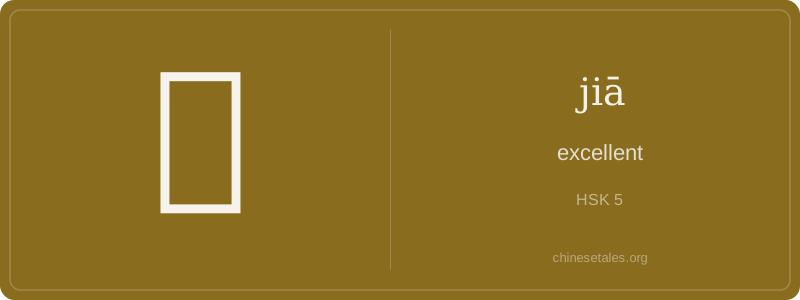
The earliest form of 嘉 appears in bronze inscriptions around 1000 BCE: a combination of 口 (mouth/speech) and 加 (to add, intensify), with an added element representing a ‘hand holding grain’ or ‘ceremonial vessel’ — suggesting ritual praise accompanied by offerings. Over time, the grain/hand element evolved into the top-right component today (the ‘士 + 口 + 一 + 口’ cluster), while 口 remained at the bottom left. Crucially, the ‘addition’ in 加 wasn’t arithmetic — it was amplification of honor, like adding incense, wine, or words to elevate a person’s status before ancestors.
This visual logic shaped its meaning: 嘉 didn’t just mean ‘good,’ but ‘so good it deserves vocalized, communal affirmation.’ In the Book of Rites, 嘉 is used to describe music so harmonious it ‘moves spirits and calms hearts’ — linking excellence to cosmic order. By the Han dynasty, it became standard in imperial edicts praising loyal ministers. Even today, the character’s structure whispers its origin: mouth (口) + intensifier (加) + ceremonial fullness — a visual symphony of sanctioned admiration.
Think of 嘉 (jiā) as Chinese culture’s 'gold star' — not just 'excellent' in a bland, dictionary sense, but the kind of excellence that earns public praise, official commendation, or ancestral pride. It’s the word used when a mayor awards a teacher for decades of service, not when you tell your friend their coffee is 'great.' Unlike English 'excellent,' which can be casual (‘excellent idea!’), 嘉 carries weight, formality, and moral resonance — it implies virtue recognized by society, not just personal taste.
Grammatically, 嘉 is almost never used alone. You won’t say *‘zhè hěn jiā’* (‘this is excellent’) — that sounds unnatural and archaic. Instead, it appears in compound verbs like 嘉奖 (jiājiǎng, ‘to commend’), adjectives like 嘉宾 (jiābīn, ‘honored guest’), or classical-style set phrases like 嘉言懿行 (jiā yán yì xíng, ‘excellent words and virtuous conduct’). Learners often mistakenly try to use it predicatively like 好 or 优秀 — a subtle but glaring error that makes speech sound like a Ming-dynasty edict.
Culturally, 嘉 evokes Confucian ideals: excellence isn’t just skill — it’s ethical, harmonious, and worthy of collective acknowledgment. That’s why it appears in place names like Jiāxīng (‘Excellent Rising’) and university names like Jiāxīng University — signaling aspiration, not just achievement. A common slip? Confusing it with 加 (jiā, ‘to add’) — same sound, totally different world: one adds numbers; the other elevates character.