型
Character Story & Explanation
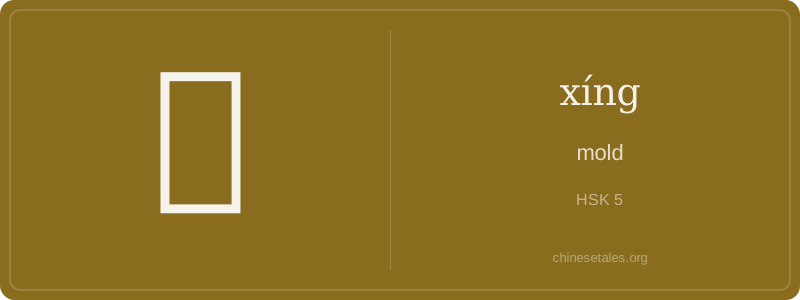
The earliest form of 型 appears in Warring States bamboo slips as a compound: a left-side 土 (tǔ, 'earth/soil') radical — representing the clay or earth used to make casting molds — and a right-side 刑 (xíng, 'punishment, model') which itself originally depicted a kneeling prisoner being measured (oracle bone script: ⺈ + 刀 + 人). Over time, 刑 simplified into 开 (kāi) plus 一, then stabilized as the modern right-hand component. The soil radical stayed firmly anchored on the left, emphasizing the material basis of replication — not abstract ideas, but tangible, reusable forms pressed into earth or bronze.
This practical origin explains why 型 never drifted into pure philosophy like 道 (dào) or 理 (lǐ). In the *Rites of Zhou*, artisans were instructed to 'cast ten vessels from one 型' — highlighting its role as a standardized master pattern. By the Tang dynasty, 型 expanded metaphorically: Du Fu wrote of 'poetic types' (诗型), and Ming novels described 'character types' (人物型). Its visual logic remains intact: 土 anchors it in the physical world, while the right side whispers 'measured form' — a silent echo of ancient foundries still shaping how Chinese speakers classify reality today.
Think of 型 (xíng) as the 'blueprint character' — it’s not just a physical mold for metal or plastic, but the conceptual template behind *any* fixed form: personality types, business models, even poetic structures. In Chinese, it carries a subtle sense of *intentional design*, not just accidental shape. You’ll rarely see it alone; it almost always appears in compounds like 类型 (lèi xíng, 'type') or 造型 (zào xíng, 'design/appearance'). Unlike English ‘mold’, which can imply restriction, 型 feels neutral or even positive — a framework that enables creativity.
Grammatically, 型 is strictly a noun (never a verb!) and almost never takes measure words directly — you say 一种类型 (yī zhǒng lèi xíng), not *一个型*. A classic learner mistake is confusing it with 形 (xíng, 'form/appearance'), leading to ungrammatical phrases like *这个型很好看* — instead, use 造型 (zào xíng) or 外形 (wài xíng). Also, note: while 型 means 'mold', you wouldn’t use it for a cake pan — that’s 模具 (mú jù); 型 implies abstraction or replication of structure, not just container function.
Culturally, 型 reflects China’s deep-rooted value of pattern recognition and classification — from ancient bronze casting molds (where the character originated) to today’s AI training 'data types'. It’s quietly omnipresent: your phone’s 'screen type', your visa’s 'category', even 'body type' in fitness ads all rely on this one character. Learners often underuse it, defaulting to 类 (lèi) — but 型 adds precision: 类 is broad category; 型 is the *archetypal form* within it.